


Garage Floor Tiles for Motorbike and Bike Storage
Garage Floor Tiles for Motorbike and Bike Storage
A garage given over to two wheels is a different environment from one that parks a car. Nothing weighs two tonnes, but the loads arrive on tiny contact patches, the floor is rarely dry, and a steady trickle of oil, chain lube and fuel ends up somewhere. The floor that copes with all of that is the one that quietly makes the space work.
Here is what matters, and how to set it up.
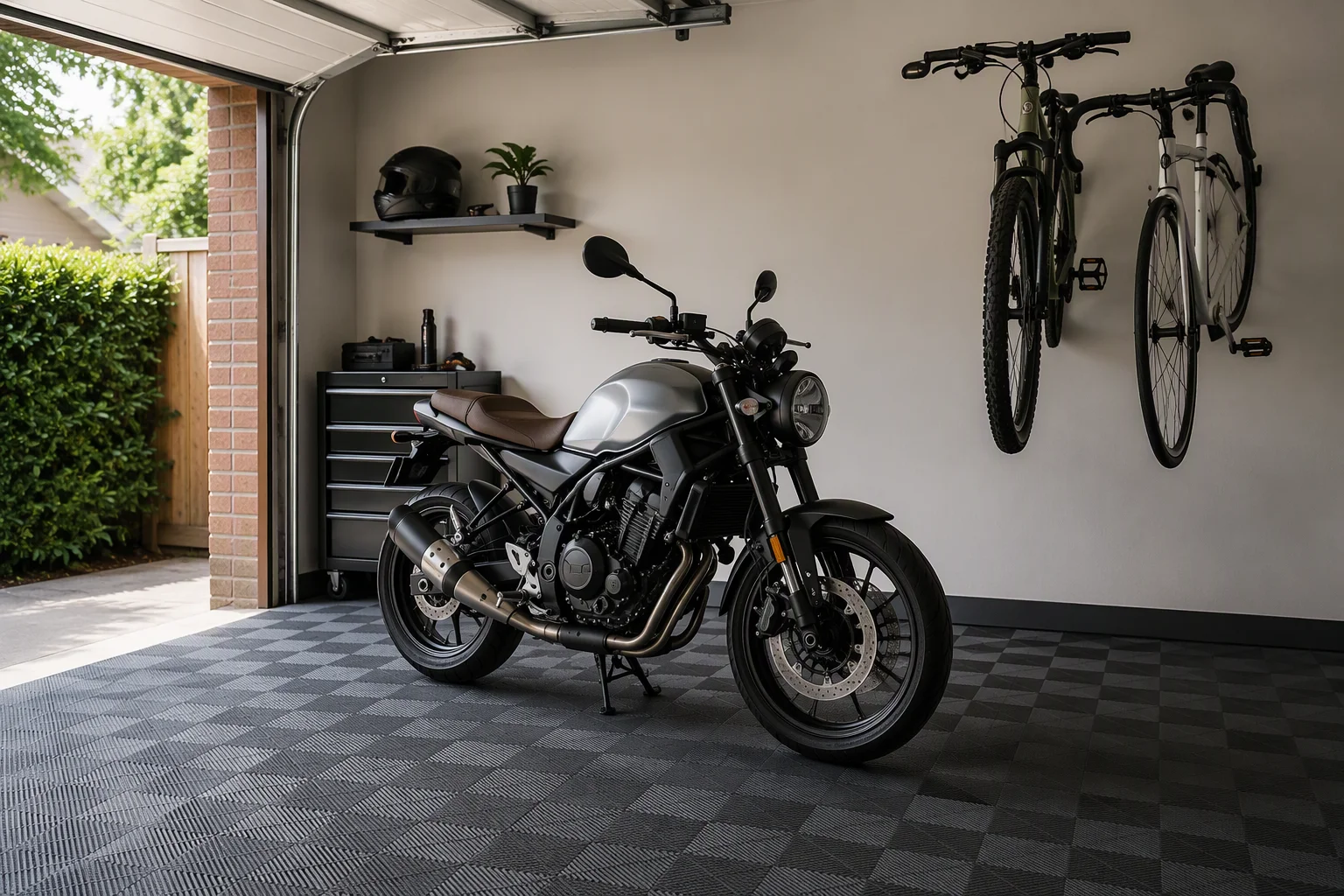
Why Motorbikes Are Harder on a Floor Than Cars
A car spreads its weight across four contact patches roughly the size of a hand each. A motorbike on a side stand puts a large share of its weight on a piece of metal perhaps three centimetres across. That is a point load, and it is a fundamentally different problem from a tyre sitting on a surface.
Add a wet tyre track twice a day, a chain that flings lube, and an engine that drips condensation onto a cold floor in winter, and the demands are clear.
What the Floor Has to Handle
Point Loads From Stands
Side stands, centre stands and paddock stands all concentrate force. On a bare slab this is harmless. On a thin covering it can crush the surface, and on a soft tile it can leave a permanent depression.
This is where a rigid polypropylene tile earns its keep: the panel spreads the load across its whole footprint and onto the slab underneath, rather than deforming at the contact point. The principle is the same one set out in our load capacity guide — spread the load, and check what the panel is rated for.
Oil, Fuel and Chain Lube
None of these are dramatic in volume, but all three arrive regularly and sit where they land. On a porous surface they soak in and become a permanent mark. On a non-porous tile they pool on the surface and wipe off, which is the single strongest argument for a plastic tile floor in a bike garage.
Chain lube is the awkward one, because it is flung rather than dripped. A wipe-down along the chain line and the rear wheel area after a ride keeps it from building into a sticky band. Our stain removal guide covers how to lift each type of mark.
Wet Tyres and Cold Condensation
Bikes come home wet far more often than cars do, and a cold engine in a cold garage produces condensation that drips onto the floor. A tiled floor drains through the seams rather than holding a film of water on the surface, so the floor is walkable sooner and the slab underneath can dry out.
Bicycle Kickstands and Pedals
Bicycles are light, but a kickstand is an even sharper point load than a motorbike side stand, and pedals scrape the floor every time a bike is wheeled out. A textured tile surface resists the scrape, and the metal contact points are the reason wall hooks and floor stands are worth using rather than leaning bikes on their stands.

How to Zone a Motorbike Garage
| Zone | What happens there | Floor priority |
|---|---|---|
| Parking bay | Stand point loads, hot engine above | Rigid tile, high point-load rating |
| Chain and service area | Lube fling, solvent, oil change | Chemical resistance, easy wipe-down |
| Wash-down spot | Soap, water, runoff | Grip when wet, drainage |
| Bicycle wall | Kickstands, pedal scrapes, wet tyres | Textured surface, hard-wearing |
| Gear and helmet storage | Drips, mud, wet kit | Easy to sweep and mop |
Practical Setup Tips
- Use a stand puck under every side stand. A wide foot spreads the load and costs almost nothing.
- Plan the tile grid around the bays. Seams lining up with the stand positions put the strongest part of the panel under the load — see our sizes and layout guide.
- Leave the perimeter free. Bikes are moved often; keeping edges clear of heavy fixed racks keeps the floor liftable — the same detailing applies as when installing around posts and steps.
- Put a drip tray under anything that leaks. A tray you empty is easier than a stain you chase.
- Anchor wall hooks into the wall, not the floor. Nothing penetrates the tile system, so nothing has to be undone later.
- Add a transition strip at the entry if the garage door apron slopes — it also keeps the wet-grit zone contained, as covered in our garage entry guide.
Cleaning a Bike Garage Floor
- Sweep dry first — grit is what scratches, and a bike garage collects plenty.
- Wipe oil and lube marks with a degreaser on a cloth rather than flooding the area.
- For a full clean, work in sections and rinse toward the door.
- Pressure washing is fine at sensible settings — our pressure washing guide gives the numbers.
- Squeegee and let it air dry with the door open.
The Bottom Line
A bike garage needs a floor that spreads point loads, shrugs off oil and lube, drains rather than holding water, and can be cleaned in minutes. A rigid interlocking tile floor does all four, and unlike a coating it can be lifted, rearranged or taken with you when the collection outgrows the garage.
Building out a bike garage? Tell us the bay layout you have in mind and we will suggest a tile size and grid: browse garage floor tiles.
