


How Long Do Garage Floor Tiles Last?
How Long Do Garage Floor Tiles Last?
Nobody asks this question when the floor looks new. It comes up two or three years in, when a traffic lane has gone slightly pale, a border tile has picked up a scuff, and the owner wants to know whether the floor is degrading or just ageing.
The honest answer is that a modular garage floor usually outlives the reason people replaced it. But "usually" hides the detail that actually matters: a tile floor does not fail all at once, and it does not fail where most people are watching. This is a practical breakdown of what governs lifespan, what wears first, and where the line sits between repairing and replacing.
The Plastic Outlasts the Joint
What the tile is doing all day
A rigid interlocking garage floor tile is a moulded polypropylene part. It is not being asked to do anything heroic: it holds a car's weight spread across four contact patches, it takes grit underfoot, and it absorbs ultraviolet light through a garage door that spends much of the day open. Polypropylene handles all three well, which is why the material itself is rarely the thing that ends a floor's life.
The three things that actually wear
In practice, floors age through three mechanisms, in this order:
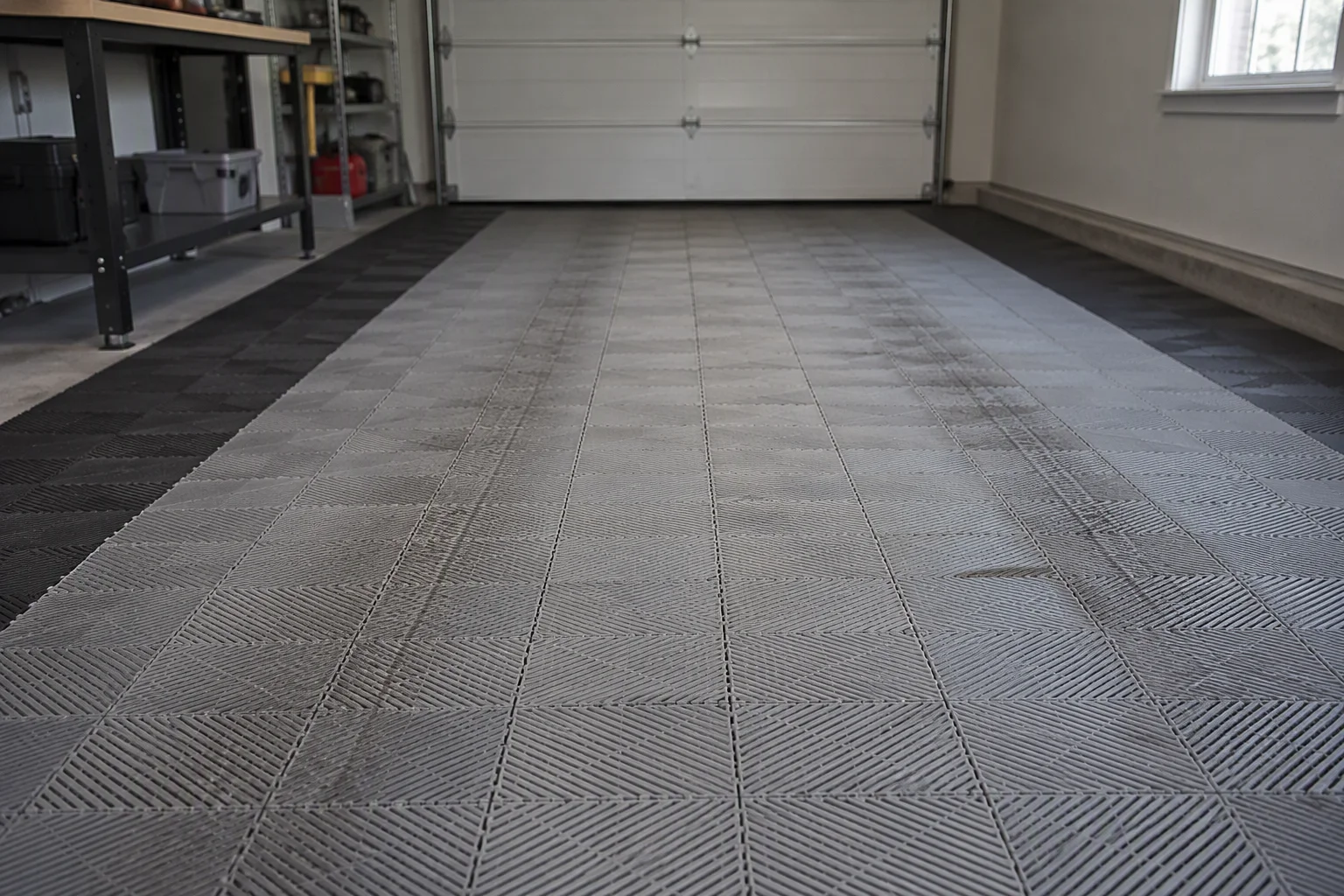
- Abrasion of the texture. Grit under a shoe or a tyre slowly polishes the moulded rib pattern. The tile is still structurally fine, but the surface reads as smoother and slightly lighter than the day it was laid.
- Pigment fade. Sunlight through an open door bleaches colour over years, unevenly — the strip near the door goes first, the shaded corner last. This is cosmetic and reversible to a point.
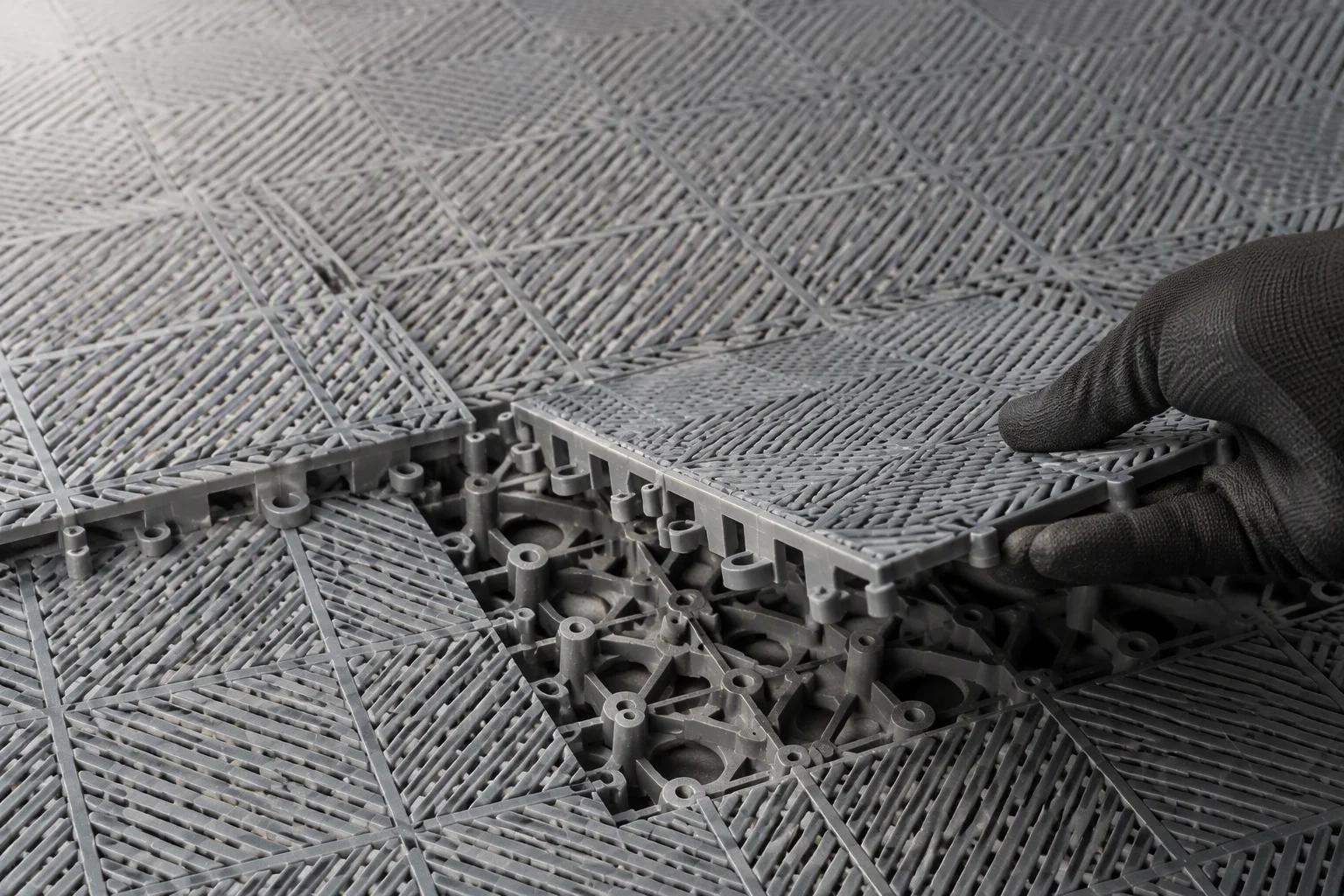
- Joint fatigue. The locking lugs and pins are the thinnest sections in the system and the only parts that flex. Repeated loading, water sitting in a seam, or a solvent left to dwell can make a lug brittle, and a brittle lug is the one failure that actually requires a new tile.
Lifespan by Use
As a rough rule, a rigid polypropylene tile in a domestic garage is a fifteen to twenty-five year floor. What moves you within that range is not brand so much as load and traffic:
- Parked car, light foot traffic. The longest case. Many floors of this kind are still serviceable after two decades, with fade the only obvious change.
- Daily driver plus kids, bikes and a workbench. Abrasion becomes visible in the traffic lane within five to eight years; structure is unaffected.
- Home gym or workshop with dropped weights and dragged equipment. Point loads do the damage here rather than time, which is why weight limits matter more than years in this scenario.
- Commercial detailing bay. Constant water, chemical contact and vehicle movement shorten the cycle considerably; a commercial floor is usually refreshed in sections rather than replaced whole.
- Outdoor apron, fully exposed. Not the intended use. UV and freeze-thaw will cut the life substantially, and no indoor tile should be judged on an outdoor installation.
Thickness shifts all of these upward. Moving from a 20 mm tile to the 30 mm range buys more material under the load and a stiffer panel that flexes less at the seams, which is exactly where fatigue starts. The full range is listed in the garage floor tiles collection if you want to compare thicknesses side by side.
What Shortens the Life
- Grit left on the floor. The single biggest accelerator. Sweeping costs nothing and removes the abrasive that polishes the texture.
- Harsh chemistry. Solvents and strong acids attack pigment and joints; which cleaners are safe covers the specifics.
- Water standing in the seams. A floor laid on a slab that drains poorly keeps moisture in the joint line.
- Dragging instead of lifting. Sliding a loaded bench or a jack across the surface catches an edge and lifts a lug.
- Laying over a dirty or uneven slab. A panel that rocks will fatigue its neighbours.
What Extends It
- Sweep weekly, wash monthly. The routine matters more than the products.
- Use edge trim on open sides. Tile edges take the impact that would otherwise lift a perimeter tile.
- Keep a spare box. Ten percent spare means a damaged tile is a ten-minute fix rather than a colour-matching exercise five years later.
- Rotate high-wear panels. Because the floor is modular, tiles from under a shelf can swap into the traffic lane. The floor then ages evenly.
- Address fade early. Pigment that has dulled but not died responds to cleaning and conditioning; restoring faded tiles explains where the limit is.
Repair Beats Replacement
This is the structural advantage tiles hold over any poured or coated floor, and it is why lifespan questions are slightly the wrong question. A cracked lug on one tile is not a floor problem; it is a one-tile problem. Lift the panel, click in a replacement, and the floor is whole again in minutes — the same panel size means the pattern and height stay continuous.
The sequence is covered in our guide to replacing damaged garage floor tiles. In most cases you do not even need to disturb the surrounding floor: a single tile can be released at its joints and swapped without lifting the field.
Signs It Is Time to Change a Tile
- A lug or pin has snapped and the tile no longer holds its neighbour
- A corner has lifted and will not seat even when the tile is free
- A hole or gouge that has gone through the wearing surface
- Staining that has penetrated the material rather than sitting on it
- Visible rocking when you step on a panel
Anything softer than that — dulling, light fading, a scuff that will not wipe out — is maintenance, not replacement.
The Bottom Line
A garage floor tiles installation should be the last floor you put in that room for a very long time. Treat grit as the enemy, keep the chemistry mild, hold a few spare panels, and the material will comfortably outlast the car parked on it. When something does fail, it will be one tile at a joint — which is precisely the failure mode a modular floor was designed to make cheap.


