


Garage Floor Tiles vs Vinyl Plank: Which Is Better?
Garage Floor Tiles vs Vinyl Plank: Which Is Better?
Vinyl plank has quietly become one of the most popular flooring products in the world. It is waterproof, it clicks together without glue, and it costs less per square foot than almost anything else that looks good. So it is a reasonable question to ask: if vinyl plank works so well inside a house, why not put it in the garage?
The answer comes down to what a garage actually does to a floor. A garage is not a laundry room with a car in it. It is a space that takes rolling loads, hot tires, road salt, temperature swings and the occasional dropped tool — and those are the conditions that separate flooring designed for vehicles from flooring designed for living rooms.
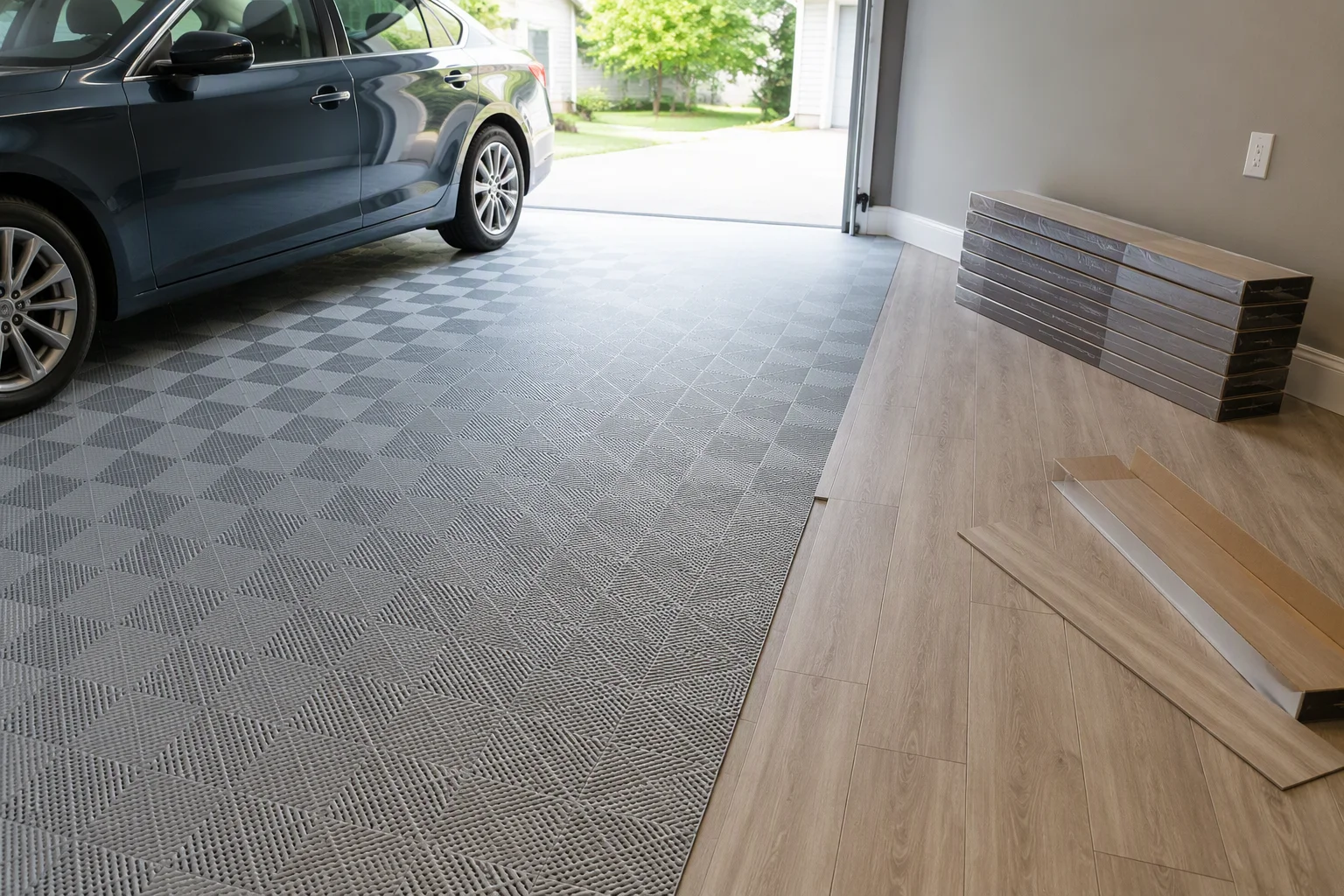
What Each Option Actually Is
Interlocking Garage Floor Tiles
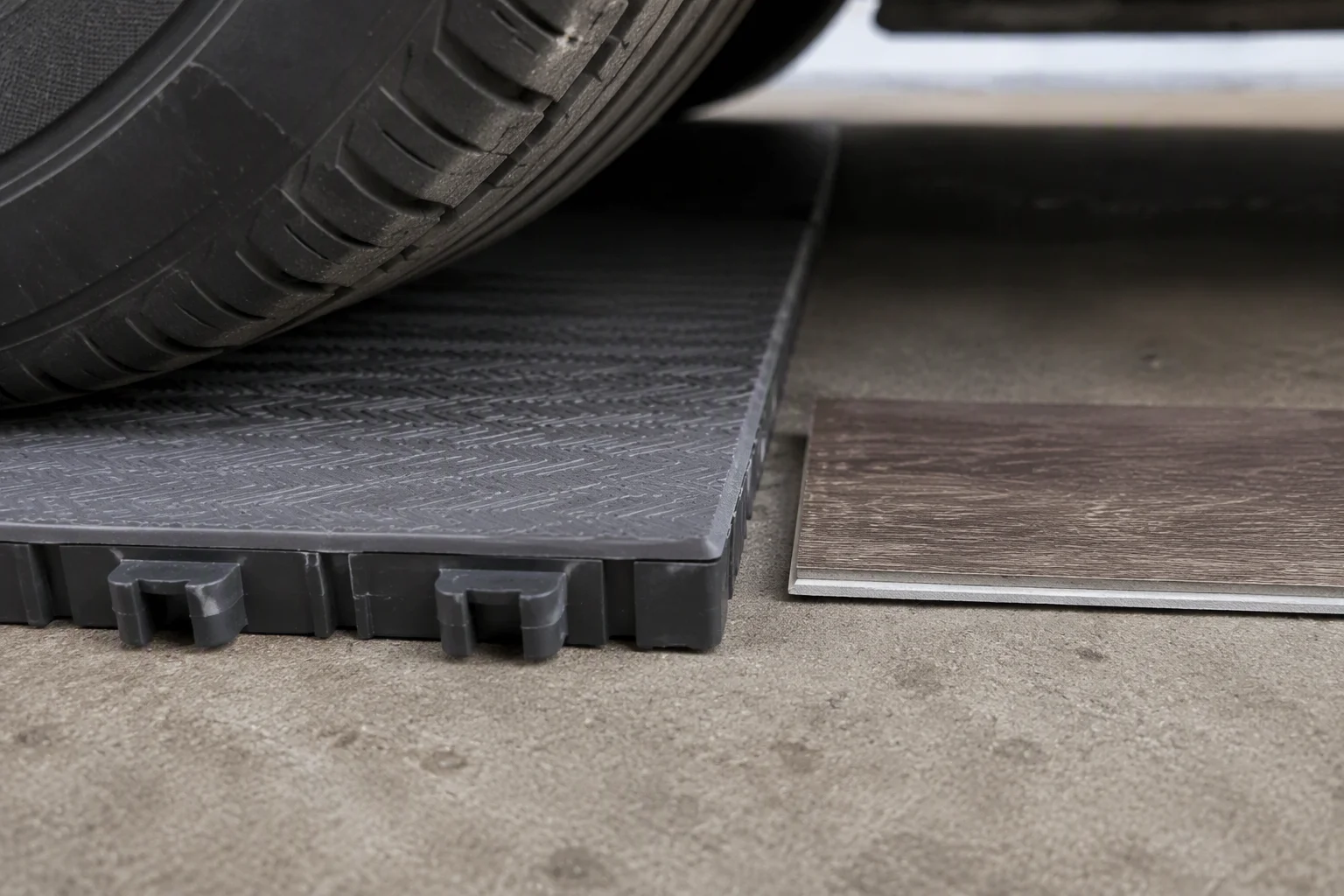
Interlocking garage floor tiles are rigid plastic panels — usually polypropylene or PVC — that snap together edge to edge with moulded connector tabs. Most are 12 x 12 inches and between 10 and 18 mm thick, with a raised rib or coin pattern on top. They are loose-laid: no adhesive, no grout, no curing time. A double garage is typically a weekend job, and the floor is usable immediately afterwards.
Because they sit on top of the slab rather than bonding to it, they can be lifted again — a detail that matters more than most buyers expect. Our guide to garage floor tile materials covers how PP, PVC and rubber behave differently in a garage.
Vinyl Plank Flooring
Vinyl plank, often sold as LVP or SPC, is a thin composite board — typically 4 to 8 mm — with a printed decorative layer and a click-lock edge. Interior versions are genuinely waterproof on the surface and highly scratch resistant. They are excellent floors for bedrooms, kitchens and basements.
What they are not is a structural floor. Nearly all residential vinyl plank carries a manufacturer restriction against vehicle traffic, and for good reason: 5 mm of composite is not built to carry a two-tonne car on four small contact patches.
Head-to-Head Comparison
| Factor | Interlocking Garage Tiles | Vinyl Plank (LVP / SPC) |
|---|---|---|
| Thickness | 10-18 mm rigid panel | 4-8 mm thin board |
| Designed for vehicles | Yes — the intended use | No — most warranties exclude it |
| Hot tire resistance | High; rubber tyres do not mark it | Low; heat can soften and dent it |
| Point loads (jacks, stands) | Handled well | Risks crushing the core |
| Water and slush | Raised rib, water drains beneath | Waterproof face, but traps under the plank |
| Installation | Snap together, no tools beyond a knife | Click-lock, needs a flat, clean substrate |
| Removable | Yes, tile by tile | Yes, but edges are fragile once lifted |
| Repairability | Replace a single tile | Often needs a run replaced |
| Typical cost | Mid to higher | Lower per square foot |
Where Vinyl Plank Falls Short in a Garage
Hot Tires and Point Loads
A tire that has just come off a summer road can be hot enough to leave a permanent impression in thin vinyl. The same is true of jack stands, which concentrate the weight of a lifted car onto a few square centimetres. Vinyl plank absorbs that pressure by deforming; garage tiles spread it across a rigid panel and a network of connectors.
Temperature Swings and Movement
An unheated garage moves through a far wider temperature range than any interior room. Vinyl plank expands and contracts with that swing, and in a large open rectangle with no rooms to break it up, the movement has nowhere to go. Planks can gap at the ends or peak in the middle. Interlocking tiles also move, but each panel is small and independent, so the movement is absorbed at the joints rather than accumulating across the whole floor.
Water, Slush and Melting Snow
Both products are waterproof on the face. The difference is where the water ends up. Vinyl plank lies flat on the slab, so meltwater from a snowy car sits in the joints and creeps underneath, where it has no way to dry. Garage tiles are raised on their own base, creating a drainage plane: water runs through the ribbed surface and out to the door, and the slab beneath can dry.
That gap is also why tiles cope better in a damp garage. Our FAQ on whether garage floor tiles trap moisture explains the ventilation effect in detail.
Where Garage Floor Tiles Win
Set against vinyl plank, interlocking tiles hold the advantage on the things a garage actually demands:
- Vehicle-rated thickness. A rigid 10-18 mm panel is engineered for the load a car puts on it; a 5 mm decorative board is not.
- Drainage underneath. Raised ribs and an open base let meltwater and wash water escape instead of pooling in the joints.
- Hot tire tolerance. Rubber and plastic tiles do not soften or stain the way thin vinyl does.
- Single-tile repair. A damaged panel unclips and is replaced in minutes — no need to disturb the surrounding floor.
- Noise and comfort. A thicker panel deadens the echo that bare concrete and thin vinyl both amplify.
- Reversible. Lift it all and the slab underneath is unchanged, which matters for rented or leased space.
Load capacity is worth checking rather than assuming, though. Our guide to garage floor tile weight limits covers what a typical panel carries and how jack stands should be supported.
Where Vinyl Plank Still Makes Sense
This is not a case of one product being bad and the other good. Vinyl plank is an excellent floor in the right room, and in a garage there are a few situations where it can work:
- A converted garage with no car in it. A home office, gym or guest room that was once a garage and now has proper insulation and climate control is a normal interior room — and normal interior rules apply.
- A storage-only garage. If nothing heavier than a bicycle ever crosses the floor, the vehicle load restriction is moot.
- Budget-first projects. Where the square footage is large and the budget is tight, vinyl plank is the cheaper way to cover a big area.
- A temporary cosmetic fix. For a quick spruce-up before a sale, it is fast and looks convincing.
If any of those describe your situation, the decision is genuinely about cost and appearance rather than durability.
Cost, Resale and Long-Term Value
Vinyl plank wins on purchase price and loses on replacement rate in a working garage. A floor that is dented by tires and lifted at the edges after one winter is not cheap — it is simply inexpensive to buy twice.
Garage tiles cost more up front, but they are effectively permanent under normal use and individually replaceable when something does go wrong. They also change how the space reads. A tiled garage looks deliberate, and deliberate-looking storage space is exactly what buyers respond to in a garage organization upgrade.
Both options need the same first step, incidentally: a clean, dry, reasonably flat slab. Skip that and neither product performs, which is why we wrote a separate guide to preparing a garage floor before installation.
Quick Decision Checklist
- Does a car, motorbike or trailer ever park on this floor? If yes, choose tiles.
- Will you use jack stands, trolley jacks or ramps? If yes, choose tiles.
- Does snow, slush or wash water reach the floor? If yes, choose tiles.
- Is the garage unheated and exposed to hard frost? If yes, choose tiles.
- Is the room fully converted and used as living space? If yes, vinyl plank is fine.
- Is the budget the binding constraint, with no vehicle use? Vinyl plank will do the job.
The Bottom Line
Vinyl plank and interlocking garage floor tiles look similar in a showroom photograph and behave nothing alike under a car. Vinyl plank is a decorative surface: thin, waterproof on top, and built for rooms where the heaviest thing that moves across it is a dining chair. Interlocking tiles are a working surface, with the thickness, drainage and load capacity a garage demands.
If your garage is a garage — with a vehicle, a jack, and weather coming in off the driveway — the tiles are the floor that will still be there in ten years. If it is really a room that happens to have a garage door, vinyl plank is a perfectly sensible choice. To match a tile to your slab and your vehicle, start with the arlott.cn garage flooring range.


