


How to Restore Faded Garage Floor Tiles
How to Restore Faded Garage Floor Tiles
After a few summers, a tiled garage floor rarely looks the way it did on day one. The colour goes flat, the surface picks up a chalky sheen, and no amount of sweeping seems to bring it back. Owners usually assume the plastic has been damaged beyond saving.
Most of the time it has not. The dullness is usually sitting on the tile rather than in it — and that distinction decides whether you are looking at an afternoon's work or a partial re-lay.
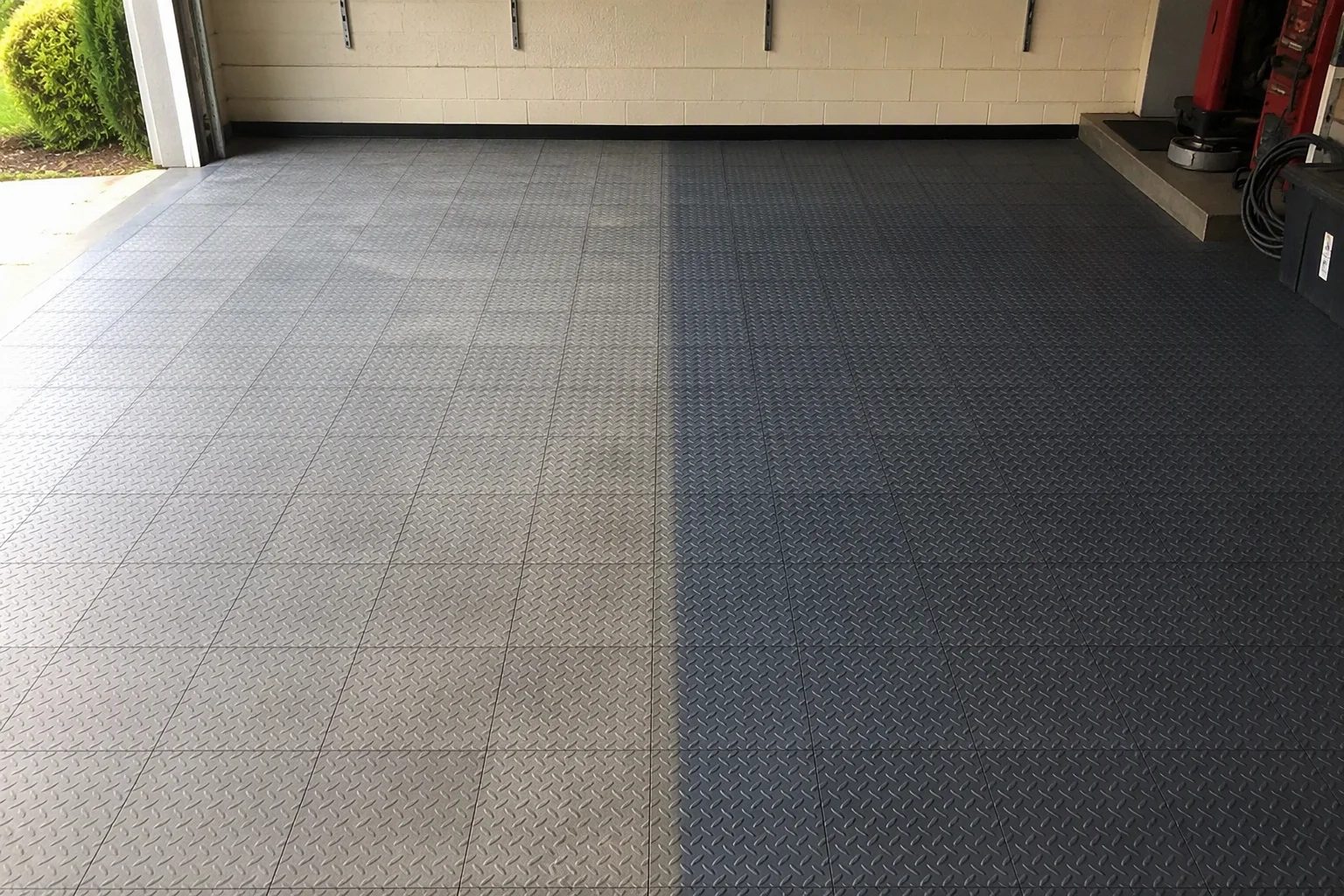
Why Garage Floor Tiles Fade and Dull
Three different things get called "fading", and they behave nothing alike.
UV Exposure
Sunlight through an open garage door bleaches pigment. This is a genuine change in the material, and it happens unevenly: the strip near the door goes first, the shaded back of the garage stays original. If your floor is noticeably lighter in one area than another, you are looking at UV bleaching.
Abrasion From Grit and Tyres
Fine grit walked in on shoes acts like sandpaper under every footstep and tyre. Over a year or two it micro-scratches the surface, and those scratches scatter light instead of reflecting it — which reads to the eye as flatness and a loss of colour depth.
Cleaning Residue Build-Up
The most common cause and the most often missed. Detergent that was never fully rinsed, or a "cleaner" that leaves a film, dries into a thin chalky layer. Repeat that monthly for a year and the floor looks permanently faded even though the plastic underneath is untouched.
What Can and Cannot Be Restored
Dullness and Grime — Fully Recoverable
Surface film and embedded grime both come off. If the tile is uniformly dull, or dullest in the traffic lanes, the material is fine and a proper deep clean will bring the colour back.
Surface Scuffs — Mostly Recoverable
Light scuffing and tyre marks can often be lifted or substantially reduced. Deep gouges cannot — a scratch that has removed material leaves a permanent line, though it usually becomes far less visible once the surrounding surface is clean.
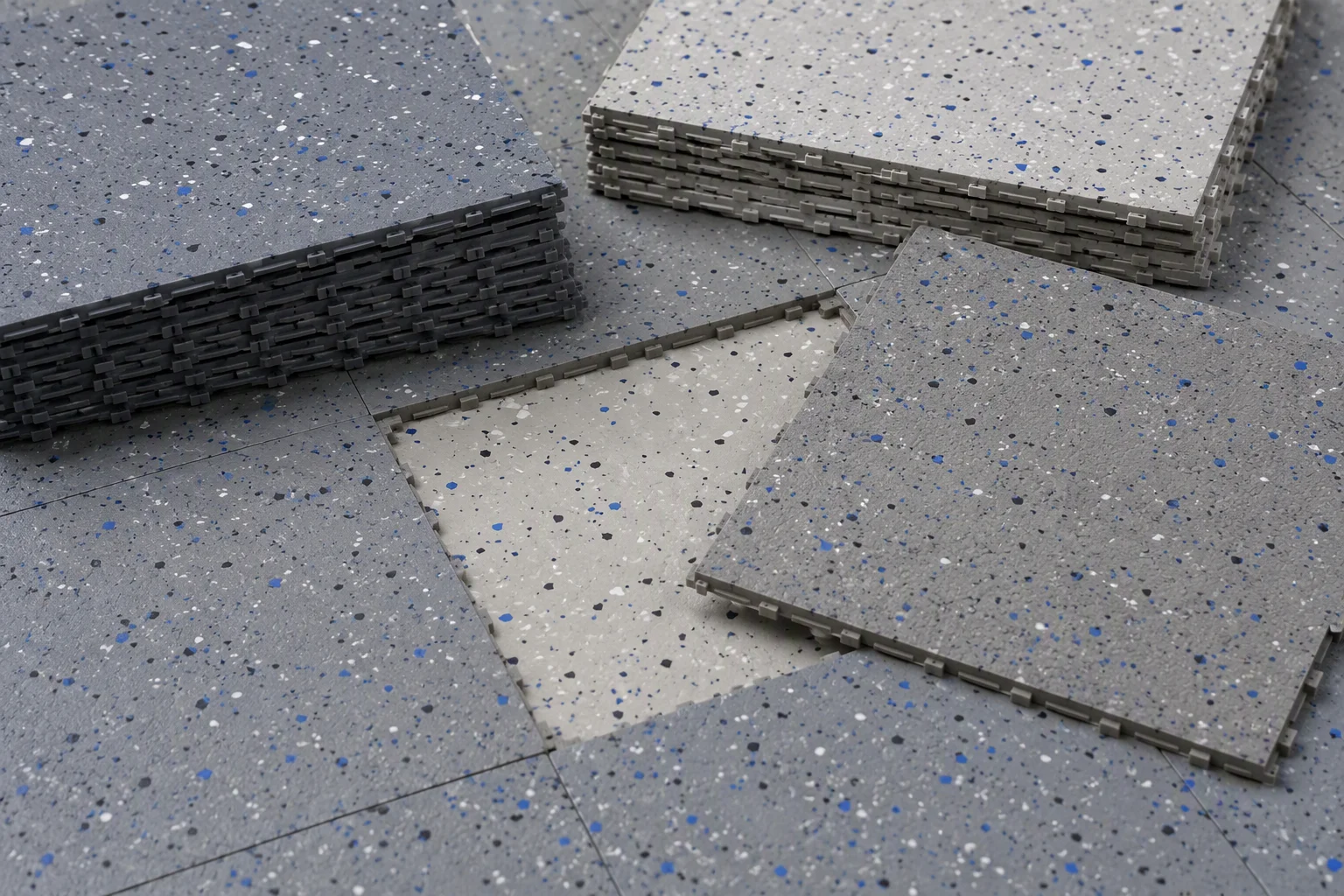
Colour Bleaching — Not Recoverable
Once UV has changed the pigment, no cleaner will reverse it. The only fix is replacement, which is why the panel-by-panel nature of a tiled floor matters so much here — you can swap just the sun-exposed strip rather than resurfacing the whole garage.
Step-by-Step: Reviving a Dull Floor
- Sweep, then vacuum. Dry grit first, always. Wetting a gritty floor just grinds it in.
- Test one tile. Pick a tile in a discreet corner and run the full process on it before committing to the whole floor.
- Wash with a mild detergent and warm water using a stiff brush. Work in sections of a couple of square metres.
- Rinse thoroughly. This is the step people skip, and it is the one that causes the chalky film in the first place.
- Deal with specific marks separately rather than by scrubbing harder — our stain removal guide covers oil, rust and tyre marks individually.
- For a heavily soiled floor, use a pressure washer at safe settings. Our pressure washing guide gives the PSI, nozzle and angle.
- Squeegee and dry. Letting it air dry with the door open avoids water spotting on a warm day.
Two things to avoid. Do not use an aggressive solvent on a whim — it can dull the surface permanently. And do not scrub with an abrasive pad; you are trying to remove a film, not material. The same restraint applies to winter salt residue, which is dealt with properly in our winter care guide.
Replacing the Panels That Will Not Clean Up
If the strip nearest the garage door is genuinely bleached, cleaning will not help. The repair is straightforward:
| Step | What to do |
|---|---|
| 1 | Confirm it is bleaching, not film — clean a small area properly and compare in daylight |
| 2 | Order replacement panels in the same colour and thickness; check the batch matches if possible |
| 3 | Work from the nearest free edge and lift the affected run of tiles |
| 4 | Fit the new panels, clicking outward from the last fixed tile |
| 5 | Rotate the faded panels into a shaded area or retire them as spares |
Blending new panels into an older floor is the one thing worth planning: see our replacement guide for how to lift a section without disturbing the rest, and our colour guide if you are choosing a new tone anyway.
Preventing Fade in the First Place
- Rinse rather than just wipe. Residue is the main cause of the chalky look.
- Sweep weekly and wash monthly. Grit does the abrasion; removing it is the cheapest protection there is.
- Use a doormat at the entry and a drip tray under the car. Most of the grit and salt arrives on tyres and shoes.
- Rotate panels occasionally if your floor is modular and the sun exposure is uneven — moving the doorway strip to the back spreads the wear.
- Keep a few spare panels. Ten years from now, the colour match will be the hard part, not the fitting.
- Accept that mid-tones age better. Very dark and very light tiles show both bleaching and grime more than a mid-grey or greige — the reasoning is in our colour guide.
If you are weighing up whether a tiled floor is worth maintaining at all, the long-run cost picture is in our value breakdown.
The Bottom Line
Most "faded" garage floor tiles are dirty, not dead. Clean properly, rinse properly, and a dull floor usually comes back to within a shade of its original colour. Where the sun has genuinely bleached the panels, a tiled floor is the one surface where the repair is a few replacement tiles rather than a resurfacing job.
Not sure whether your floor needs cleaning or replacing? Send us a photo taken in daylight and we will tell you which it is: browse garage floor tiles.
