


The Rise of Rental-Friendly Garage Floor Tiles
The Rise of Rental-Friendly Garage Floor Tiles
For years, the advice given to anyone renting a house with a grim garage floor was the same: live with it. Coatings are permanent, adhesives are permanent, and a landlord who finds a modified floor at inspection time is rarely pleased. That assumption is being challenged — not by a new product, but by a change in how people treat the space they rent.
Interlocking garage floor tiles sit at the centre of that shift. They were designed for homeowners, but the property that made them popular — nothing is fixed, nothing is glued, and the whole floor can come back up — turns out to matter most to people who do not own the slab underneath.
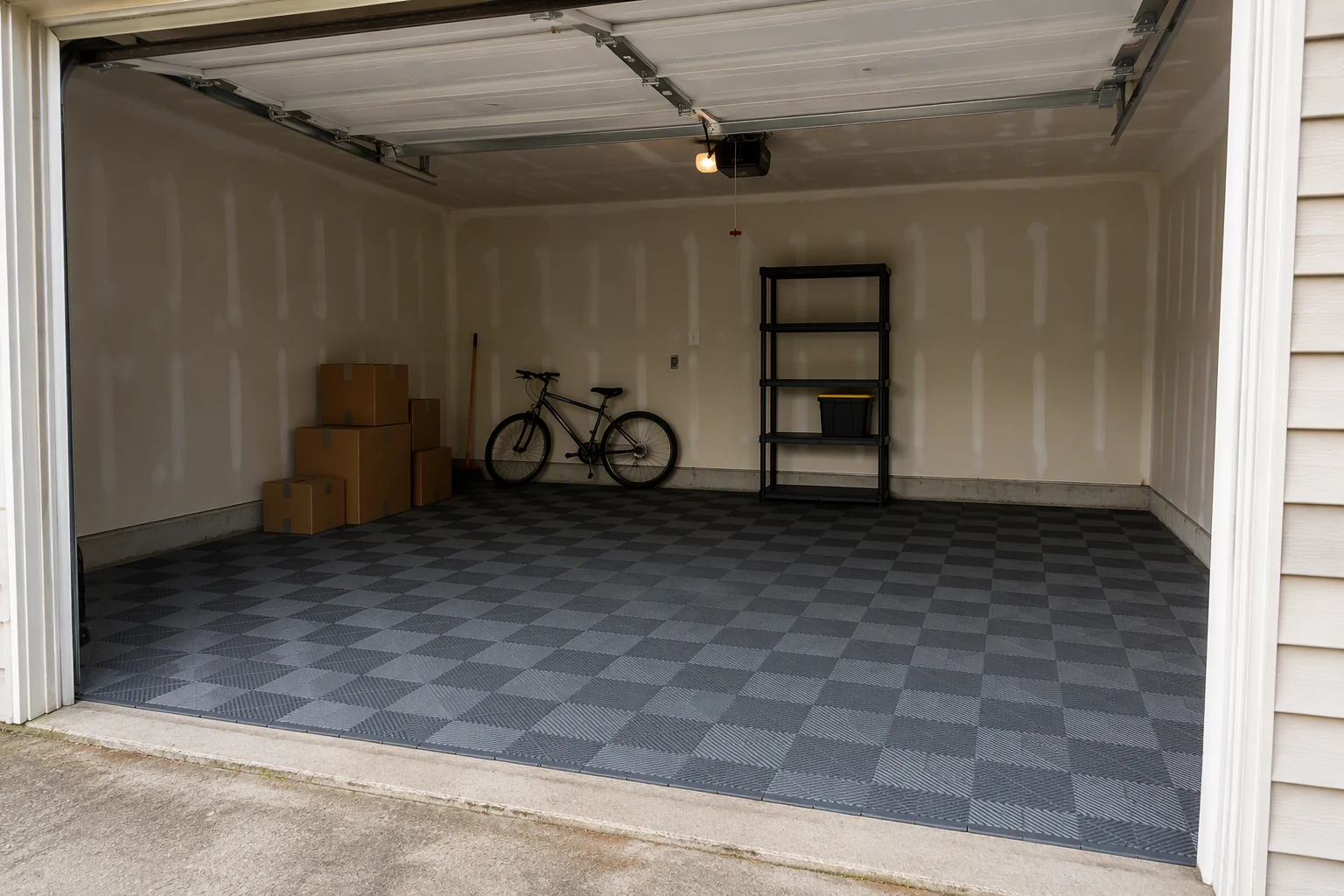
Why Renters Have Been Left Out of Garage Flooring
Almost every traditional garage floor option assumes ownership. Epoxy and polyaspartic coatings cure onto the concrete and cannot be removed without grinding. Floor paint behaves the same way. Peel-and-stick vinyl leaves adhesive residue. Even a simple concrete sealer changes the surface permanently.
For a tenant, all of that creates the same problem: an improvement that becomes a liability at the end of the tenancy. The cost of undoing it usually exceeds the cost of doing it in the first place, and the deposit is what pays for the difference. It is the same reasoning behind our honest breakdown of whether garage floor tiles are worth it — value depends entirely on how long the floor has to pay for itself.
Modular tiles break that trade-off. They rest on the slab under their own weight, connected to each other rather than to the building. Nothing penetrates the concrete, so nothing has to be repaired later.
What Makes a Floor Truly Rental-Friendly
"Removable" gets used loosely in flooring marketing. For a rented property, four tests actually matter.
No Adhesive, No Fixings
The tiles must hold themselves down through their own weight and the interlocking connectors alone. If installation calls for glue, tape, screws or a primer, it fails the first test — regardless of how easily the manufacturer claims it comes up.
Reversible Without Damage
A genuinely rental-friendly floor leaves the slab in the condition it was found in. That means no residue, no etched patches, no drilled holes and no lifted surface. It also means the reversal has to be something one person can do in an afternoon, in the same spirit as the DIY methods in our guide to replacing damaged garage floor tiles.
Portable to the Next Address
The strongest argument for modular flooring in a rental is that it is not a sunk cost. A tiled floor can be lifted, stacked, moved and re-laid in the next garage — which means the money spent is an asset that travels, rather than an improvement handed to the landlord.
Deposit-Safe
The final test is the one tenants care about most. If a floor can be removed cleanly and the slab underneath is untouched, there is nothing for an inspection to flag. That single property removes most of the risk from the decision.
What to Check Before You Lay Anything
Modular tiles lower the stakes considerably, but a rented garage still deserves a few checks first:
- Your tenancy agreement — confirm whether alterations to the garage are restricted, and whether the garage is even part of the let.
- Landlord permission in writing — a short message confirming a removable, non-fixed floor is acceptable is worth more than any verbal agreement.
- Slab condition — cracks, damp patches and old coatings rarely block installation. Our FAQ on garage floor tiles over uneven concrete covers what a tired slab can and cannot take.
- Door clearance — measure the gap under the garage door and any internal door; tile plus base height has to clear it.
- Drainage position — note where the floor drains or slopes, so water still finds its way out; the same principle as a garage boot and wet-weather zone.
- A photographic record — date-stamped photos of the empty slab, taken before installation, are the cheapest insurance you can buy.
Working out how to cut and finish around posts, steps and door frames is covered in our installation guide for laying tiles around obstacles — useful in a rented garage, where you cannot simply move the obstruction.
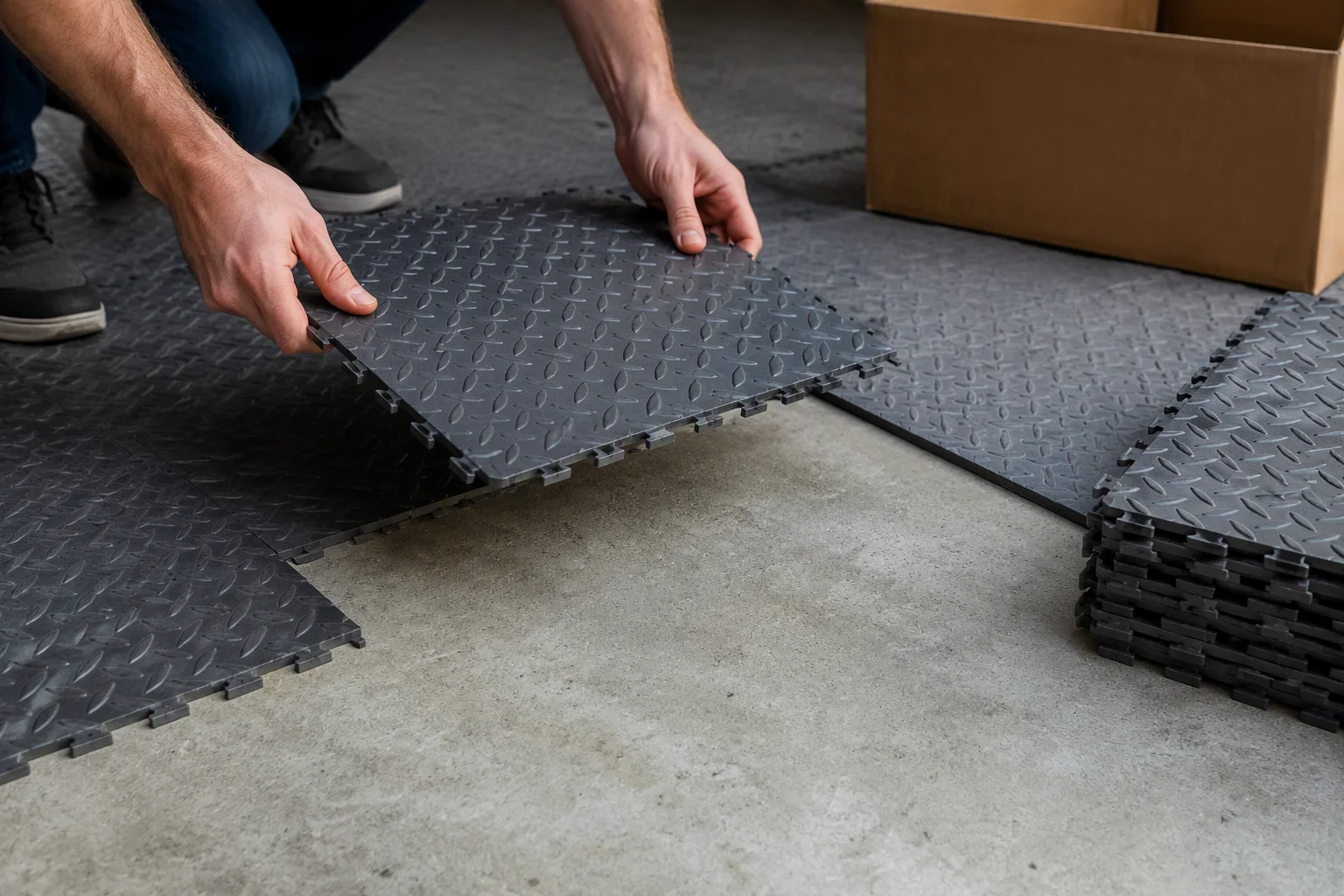
Fixed vs Modular in a Rented Garage
| Consideration | Coating or sealer | Interlocking tiles |
|---|---|---|
| Permission needed | Usually yes — permanent change | Often a courtesy note only |
| Effect on the slab | Bonded or etched surface | None |
| Reversal | Grinding, specialist labour | Lift by hand |
| Deposit risk | Real, if the finish fails | Low |
| Move-out time | Days, plus repair | An afternoon |
| Travels to the next home | No | Yes |
| Installation downtime | Curing time required | Use immediately |
Moving Out: A Five-Step Reversal
If the floor has to come up, the sequence is straightforward — and worth doing in order so nothing gets damaged on the way out.
- Clear the garage completely. Emptying the space first avoids lifting tiles around furniture and dropping things onto exposed concrete.
- Photograph the laid floor and the slab edge. This documents that the tiles and the concrete beneath are intact.
- Disconnect in reverse order. Start at the last row you laid and work backwards; panels release far more easily when you follow the direction the connectors were closed in.
- Stack and strap. Stacks of around ten to fifteen tiles are manageable to carry. Strap or box them, and store the edge trims separately so they do not bend.
- Sweep and inspect the slab. Wipe up any grit, check nothing has stained the concrete, and take a final photo set to compare with the "before" shots.
Where This Trend Is Going Next
The shift is not really about flooring. It is about a growing group of people who want a space to work properly without treating it as a permanent investment.
Short Tenancies and Shared Houses
Where tenancies run for a year or two, permanent improvements rarely make sense. A floor that can be installed on a Saturday and removed the following year fits the way these households actually live, and the resale of used tiles keeps the entry cost down.
Community and Hobby Spaces
The same logic applies beyond housing. Men's sheds, club workshops, shared makerspaces and short-lease commercial units all occupy buildings they do not own, and all of them want a floor that can be removed when the lease ends. The requirements look a lot like those of a shared garage used for motorbike and bike storage — grip under small contact patches, easy cleaning, and a floor that survives being taken apart.
The Bottom Line
Renting used to mean accepting whatever floor came with the building. Modular garage floor tiles remove that constraint: they need no adhesive, they leave no trace on the slab, they can be lifted in an afternoon, and they travel with you to the next address.
Maintenance stays simple too — a hose and a brush deal with most of it, as set out in our guide to pressure washing garage floor tiles safely. If you are still choosing, start from the arlott.cn garage floor tile range and match the tile to the traffic the space actually sees.
If you are weighing the cost against a coating, the comparison is not like for like — one is a permanent improvement to someone else's building, and the other is a floor you own that happens to be resting on it. For a rented garage, that difference is usually the deciding factor.


