


Which Cleaners Are Safe for Garage Floor Tiles?
Which Cleaners Are Safe for Garage Floor Tiles?
Most garage cleaning advice online was written for concrete or for an epoxy coating. Both of those are surfaces you can attack fairly hard: concrete is porous stone that shrugs off almost anything because there is nothing to dissolve, and a cured coating is a sacrificial layer that can be abraded and re-coated. Modular tiles are neither. They are moulded plastic parts with pigments, ultraviolet stabilisers and a moulded texture built into the surface, and the chemistry that reaches them either leaves that surface alone or starts taking it apart.
That is why a product that works brilliantly on a driveway can leave a garage floor tile looking chalky and pale in one afternoon. This guide sets out what is safe, what is not, and what to reach for when a specific mess appears.
Why the Cleaner Matters More Than the Dirt
What an interlocking tile is actually made of
A rigid garage tile is usually polypropylene, a softer flexible one is usually PVC, and a rubber tile is a different material again. Each behaves differently in contact with solvents, acids and strong alkalis. Our breakdown of garage floor tile materials covers how those three families compare, and it is worth knowing which one you own before you buy any bottle with a warning label on it.
The two ways a cleaner damages a tile
Damage rarely shows up as a hole. It shows up in one of two quieter forms:
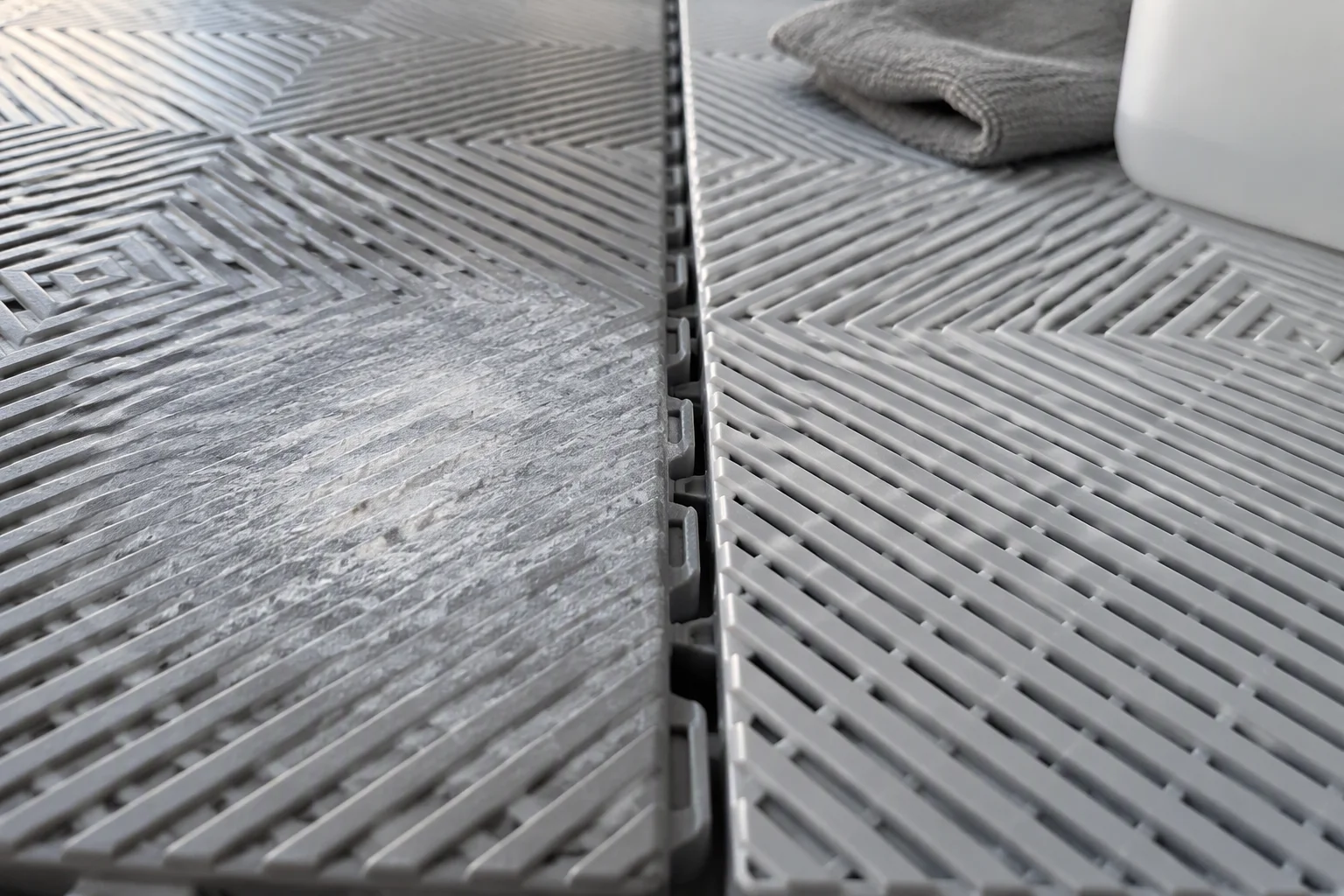
- Surface attack. A strong solvent softens the top layer, lifts pigment and leaves a pale, slightly tacky patch that never quite comes back. The texture looks intact, but the colour has gone flat.
- Joint attack. Acids and strong alkalis work on the locking lugs and the thin sections around them. The tile does not discolour, it goes brittle — and one day a lug snaps off when you lift a panel.
Cleaners That Are Safe
Everything on this list is ordinary household chemistry. None of it needs protective equipment beyond gloves, and none of it will shorten the life of the floor.
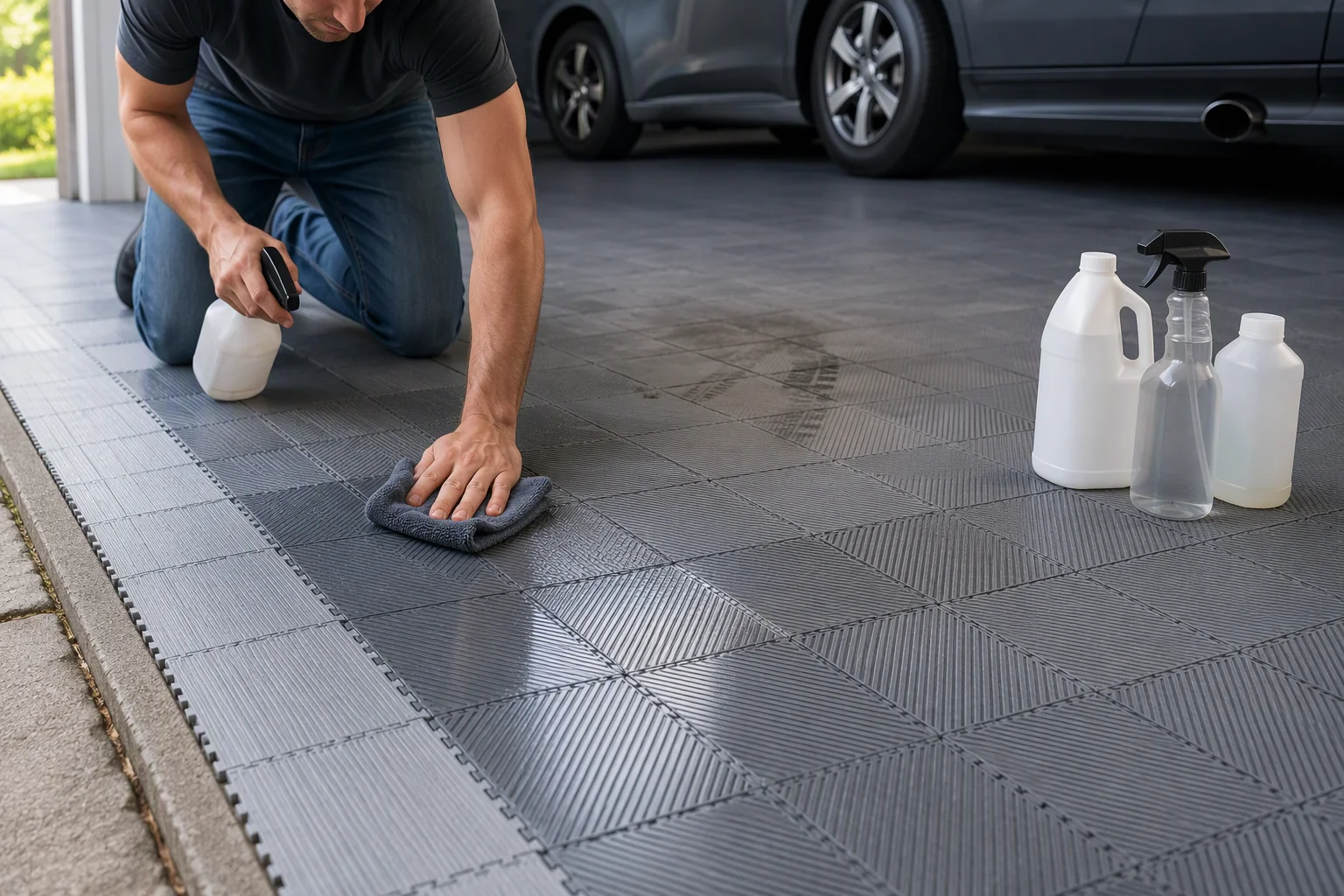
- Warm water with a few drops of dish soap. The default for weekly cleaning. A teaspoon in a bucket of warm water is enough; more soap just means more residue to rinse.
- pH-neutral floor cleaner. Useful on light-coloured tiles where soap film shows. Dilute per the label and rinse.
- Isopropyl alcohol, wiped and removed. Good for adhesive residue, ink and small sticky marks. Do not flood the joint with it and do not leave it to sit.
- Degreasers formulated for plastic or painted surfaces. The right choice for oil and tyre marks, provided the label does not list solvents you would use outdoors only.
- Baking soda paste. A mild abrasive for scuffs. Work it in gently with a cloth, not a scouring pad.
- White vinegar, heavily diluted, rinsed off. Fine for hard-water film near a door. Never left standing, and never mixed with bleach.
- Enzyme or oxygen-based cleaners. Effective on organic spills and odour, and gentle on pigment.
Whatever you choose, the technique matters as much as the product: apply, work briefly, rinse with clean water, then dry. A cleaner left to evaporate is a concentrated residue sitting in a texture.
Cleaners That Cause Damage
This is the list worth remembering, because several of these are the fastest way to clean a bare slab and the fastest way to ruin a tile floor.
- Concentrated solvents — acetone, lacquer thinner, xylene, MEK, and most "heavy duty" adhesive removers. They soften the surface and strip pigment.
- Muriatic acid and strong descalers. Sold for concrete prep, and genuinely destructive to the locking system.
- Caustic soda and oven-style degreasers. Strong alkalis that attack joints and dull colour.
- Bleach at full strength. Not an instant disaster, but repeated use leaves a floor looking washed out and yellowed.
- Abrasive pads and wire brushes. They scratch the moulded rib pattern, and a scratched texture holds dirt permanently.
- Steam cleaners and pressure washers held close. Heat and force together can lift an edge and drive water under the panels.
If you have already used one of these, all is not lost. Our guide to restoring faded garage floor tiles covers what actually brings colour back and what only hides the problem for a month.
Matching the Cleaner to the Mess
Most garage floor problems are one of a handful of recurring events. Treat them specifically rather than reaching for the strongest bottle in the cupboard.
- Engine oil and grease. Scrape off any solid residue, apply a plastic-safe degreaser, give it a few minutes, agitate with a soft brush and rinse. Repeat rather than escalate the strength.
- Tyre marks. A degreaser and a microfibre cloth, worked along the rib direction. Do not sand them.
- Rust blooms. A weak acid gel made for rust removal, applied only to the spot, then rinsed thoroughly and dried. Keep it off the joints.
- Paint and primer. Water-based paint lifts with warm water while it is still soft. Cured paint needs a plastic scraper and patience, not thinner.
- Road salt and winter grime. Warm water, a little soap and a full rinse. Salt is a rinsing problem, not a scrubbing problem.
- Brake fluid and coolant. Blot immediately with absorbent cloth, then wash with soapy water. These are the spills worth chasing within minutes.
- Mildew in a damp corner. Diluted vinegar or an oxygen-based cleaner, then fix the ventilation — the growth will return otherwise.
For the stubborn cases that resist all of the above, our piece on removing tough stains goes deeper on dwell time and agitation. And if you were planning to hose the whole floor down, read whether you can pressure wash garage floor tiles first — the answer is more conditional than most people expect.
A Cleaning Routine That Protects the Floor
- Weekly: sweep or blow out grit. Grit underfoot is what wears a texture smooth over years.
- Weekly: damp mop with warm soapy water, then a clean-water pass. Two buckets, not one.
- Monthly: lift one panel from a high-traffic area and check underneath. Grit and moisture collect there first.
- Seasonally: deep clean the full floor, rinse twice and leave the door open to dry.
- After winter: rinse the first two metres inside the door specifically, where salt accumulates.
The full version of this routine, including what to do at each change of season, is in our garage floor care guides.
When Cleaning Is Not the Answer
Two situations do not respond to better chemistry. The first is a tile whose colour has genuinely gone — usually from solvent contact or years of full-strength bleach. The second is a tile with a cracked lug or a lifted corner, which will keep trapping water no matter how often you clean it.
Both are cheap to solve because the floor is modular. A single damaged panel lifts out and a replacement clicks into the same grid, which is the practical advantage tiles hold over any poured or coated surface. Our walkthrough on replacing damaged garage floor tiles covers the sequence, and if you are still deciding on a colour scheme, the Arlott garage floor designer lets you lay out patterns and see them before you order.
The Bottom Line
Safe cleaning of interlocking floor tiles comes down to one habit: use the mildest thing that works, rinse it off, and dry the floor. Warm water and a little dish soap will handle the overwhelming majority of what a garage throws at a floor. Save the strong products for the slab you are prepping, not the tiles you are living on — and when a mark truly will not shift, treat it as a stain to be managed rather than a surface to be conquered.


