


Garage Floor Tile Weight Limits: What Can They Hold?
Garage Floor Tile Weight Limits: What Can They Hold?
"Can this floor take my truck?" is the most common question we get before an order — and it deserves a straight answer rather than a marketing one. Interlocking garage floor tiles are engineered to carry vehicles, but what they can handle depends on thickness, how the load is spread, and whether you're talking about rolling weight or point load.
Here's the honest breakdown, question by question.
How Tiles Carry Weight
A garage floor tile isn't a solid block — it's a ribbed shell. The top surface sits on a grid of internal ribs that transfer load down to the slab below. That structure is why a relatively light tile can carry a two-tonne vehicle:
- The ribs spread load across the whole tile, not just the point where the tire sits
- Tiles interlock into a continuous mat, so weight from one tile is shared with its neighbours
- The concrete slab does the real work — the tiles distribute load onto it evenly and protect the surface
- Thicker tiles have taller ribs, which is what increases stiffness and load capacity
The Quick Answer by Vehicle Type
For mid-grade tiles (around 30 mm) laid on a sound concrete slab:
| What's on the floor | Typical load | Works? |
|---|---|---|
| Motorcycle / bicycle | 100–300 kg | Yes — any thickness |
| Sedan or hatchback | 1,200–1,600 kg | Yes — 18–20 mm and up |
| SUV or pickup | 2,000–3,000 kg | Yes — 30 mm recommended |
| Loaded van / light truck | 3,000–4,500 kg | Yes — 30–40 mm |
| Rolling tool chest (loaded) | 150–400 kg | Yes — any thickness |
| Heavy equipment / excavator | 5,000 kg+ | Not recommended — use steel plates |
These are working guides, not certification. Your slab condition, tile grade and contact pressure all matter — if you're planning a heavy commercial installation, talk to us with your axle weights before ordering. Our thickness guide explains how to match grade to load.
Common Weight Questions
Can you park a car on interlocking garage floor tiles?
Yes — that's the primary use case. A normal car exerts roughly 400–600 kg per axle, spread across two tires and then across multiple interlocking tiles. With 30 mm tiles on a sound slab this is well within capacity. The failure mode to avoid isn't weight, it's heat and point load: a hot catalytic converter or exhaust sitting directly on the tile.
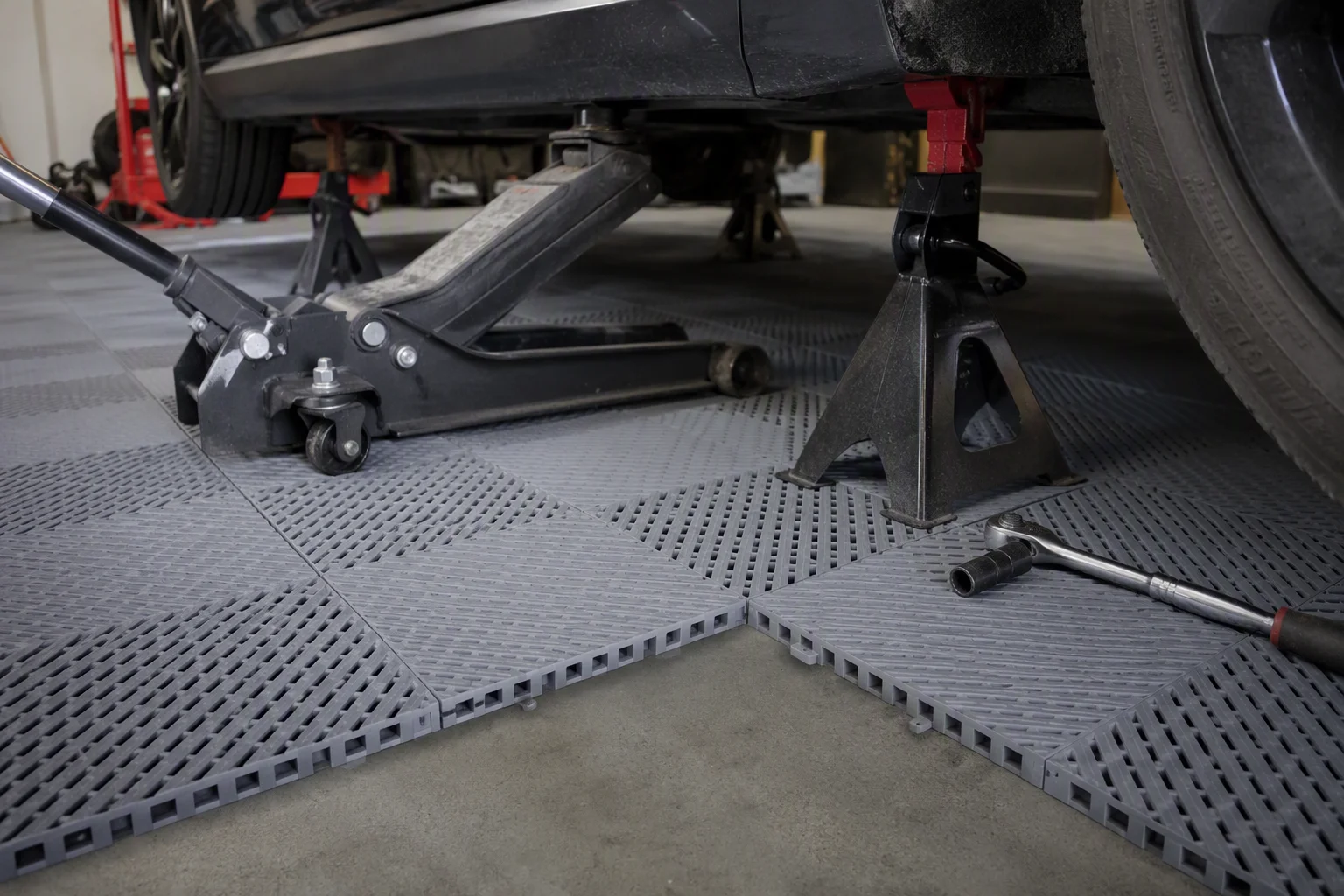
Can you use jack stands on garage floor tiles?
Yes, but spread the load. A jack stand foot is small, so the pressure under it is high; that's what can dimple a tile over time. Put a steel plate, a piece of plywood or a jack stand pad under each stand and the load spreads across several tiles. Never use a metal-edged stand directly on the tile surface during a long job.
Will a two-post lift work on tiles?
No. A two-post or four-post lift must be anchored into the concrete slab, not into a floating tile floor. If you're installing a lift, plan the layout so the lift posts sit on exposed slab, and tile around them — the same approach we describe for fitting tiles around obstacles.
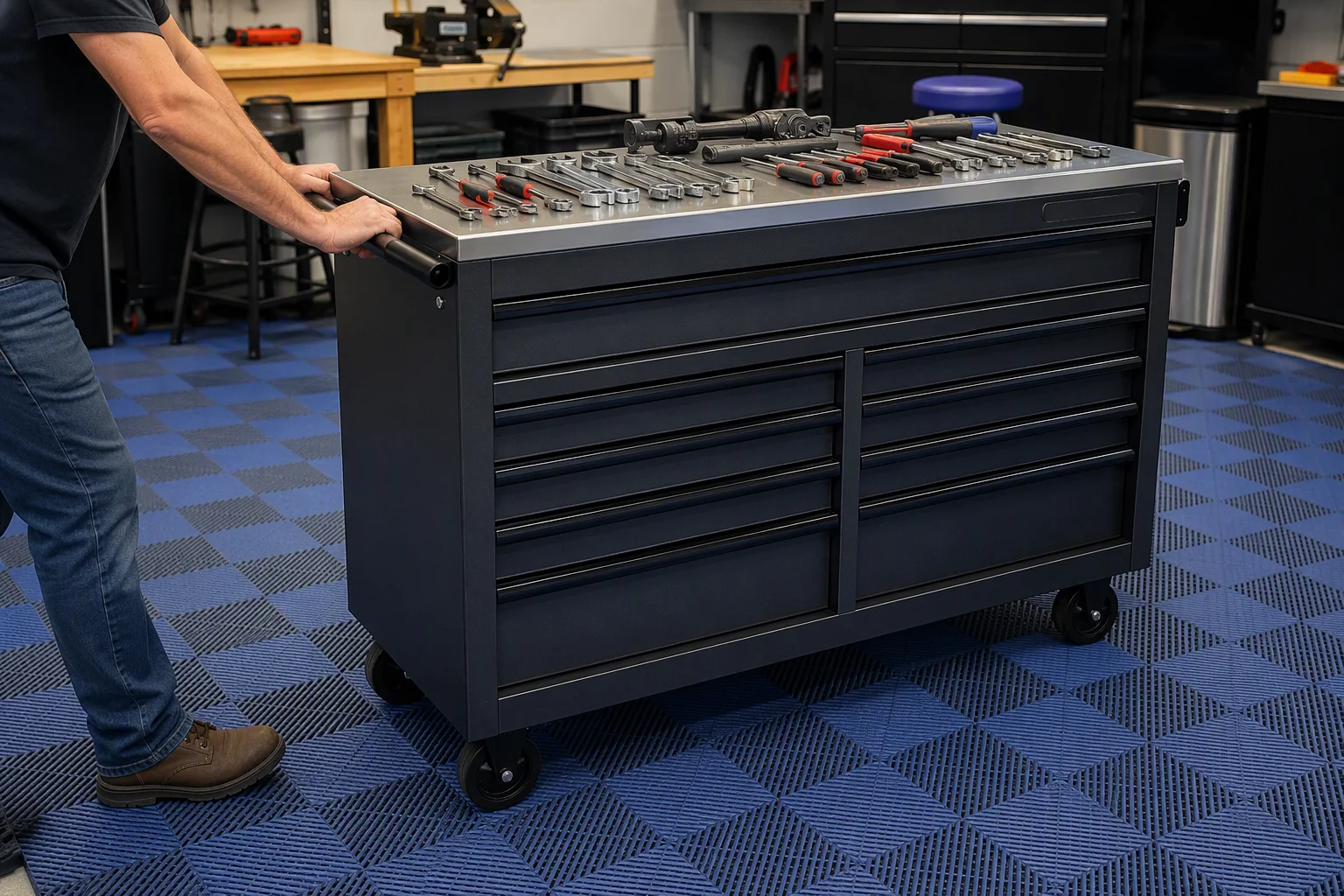
Can you roll a loaded tool chest over the tiles?
Yes. Loaded tool chests are heavy but their casters spread the load and roll smoothly on a flat tile surface. The main caution is grit: sweep the floor first, because dragging a gritty caster across a tile can scuff it. Tiles roll far better than bare concrete, which is one reason workshop setups favour them.
Does a motorcycle side stand damage the tiles?
Over time, yes — a side stand concentrates the whole bike's weight on a coin-sized contact patch. Use a side-stand puck or a small plate. Otherwise motorcycles are one of the lightest loads a garage floor ever sees.
Can the tiles take a fully loaded workbench?
Yes. A fully loaded bench might weigh 300–500 kg across four legs — the load per leg is modest and well within capacity for any grade. The thing to check is the bench's own feet: sharp metal edges sitting under constant load are best placed on small plates.
What about a loaded trailer or caravan?
Static parking is fine on thicker tiles. The caution is manoeuvring: a heavy trailer with a jockey wheel concentrates a lot of force on one small wheel, and twisting it in place creates the kind of shear load that loosens connectors. Pull straight, don't pivot.
What Actually Breaks Tiles
Weight alone rarely does it. These do:
- Point loads: jack stands, side stands, sharp furniture feet and steel edges resting on one small spot
- Heat: a hot exhaust or catalytic converter parked directly over a tile, or a dropped welding spatter
- Shear and drag: pivoting a heavy trailer or dragging a loaded pallet sideways across the floor
- Impact: dropping an engine block or brake drum from height
- Chemical attack: brake fluid, battery acid and concentrated solvents left to sit
- Grit underneath: trapped sand or gravel grinding between tile and slab over years
Notice that most of these are preventable with a plate, a mat or a sweep — and if a tile does take damage, it's a five-minute single-tile repair rather than a resurfacing job.
Choosing the Right Thickness for Your Load
Thickness is the load dial:
- 18–20 mm: light vehicles, gyms, storage areas, pedestrian traffic
- 30 mm: the mainstream choice for cars, SUVs and home workshops
- 40–50 mm: loaded vans, light trucks, commercial bays and heavy rolling loads
If your plan includes heavy vehicles, multiple bays, or commercial traffic, size up one grade rather than pushing the limits of a thinner tile. And if you're comparing material types at the same thickness, our comparisons of tiles against PVC and tiles against rigid ceramic cover how each behaves under load.
FAQ
How much weight can 30 mm garage floor tiles hold?
On a sound slab, a mid-grade 30 mm tile carries normal passenger vehicles — sedans, SUVs and most pickups — plus benches, tool chests and pedestrian traffic. For loads above that range, step up to 40–50 mm tiles.
Do I need a thicker tile for a heavier car?
For most passenger vehicles, no — 30 mm is already comfortably sufficient. Thicker tiles become relevant for loaded vans, light trucks and commercial rolling traffic, where they add stiffness and resist long-term deformation.
Will the tiles crack under my car?
Under normal parking loads, no. Cracking comes from point loads, heat and impact, not from a car's weight spread across four contact patches. Use plates under jack stands and let hot exhaust components cool before parking.
Can tiles be used in front of a lift or on a heavy-use commercial floor?
Around an anchored lift, keep the post footprints on bare slab. For heavy commercial traffic, choose the thickest grade and confirm your axle loads with us before ordering — that's exactly the conversation worth having before you buy, not after.
The Bottom Line
Garage floor tiles carry vehicles comfortably when the load is spread — that's what the ribbed structure and interlocking mat are designed for. Protect against the three real enemies (point loads, heat and shear), choose thickness based on your heaviest vehicle rather than your lightest, and a tile floor will outlast several rounds of epoxy.
Tell us what you park and what you work on, and we'll match the grade: browse garage floor tiles built for vehicle loads.
