


Garage Floor Tiles Over Uneven Concrete: Your FAQ
Garage Floor Tiles Over Uneven Concrete: Your FAQ
Almost nobody has a perfect garage slab. There is a crack near the door, a low spot where water pools, a slope toward the drain, an expansion joint that has lifted a few millimetres. The question every buyer asks before ordering is the same: does any of that rule out interlocking tiles?
Usually the answer is no — interlocking tiles are more forgiving of a tired slab than almost any other floor covering. But "forgiving" is not "unlimited", and knowing the difference saves a disappointing weekend.
The Short Answer
Interlocking garage floor tiles are rigid panels that rest on the slab and lock to each other, not to the concrete. That single design detail is why they handle an imperfect floor so well:
- They span minor dips and hollows instead of mirroring them
- They bridge hairline and moderate cracks without cracking themselves
- They tolerate a normal drainage slope, because each panel simply tilts
- They need no adhesive, so nothing has to bond to a damaged surface
- They can be lifted later if you do decide to repair the slab properly
What they cannot do is hide a serious structural problem or fix standing water.
What Tiles Can and Cannot Bridge
| Slab condition | Usually fine? | Notes |
|---|---|---|
| Minor unevenness (a few mm over a metre) | Yes | The most common case; tiles simply span it |
| Hairline and moderate cracks | Yes | Cracks must be dormant, not widening |
| Normal drainage slope toward the door | Yes | Panels tilt with the slab; no adjustment needed |
| Shallow pitting and surface spalling | Usually | Sweep and fill loose material first |
| Expansion joints and control joints | Yes, with care | Slight step-down possible; plan tile alignment |
| Deep hollows or a pronounced dip | Needs prep | Panels can rock; levelling compound or shims needed |
| Slab heave, settlement or active cracking | No | Structural issue — repair before flooring |
| Standing water that cannot drain | No | Fix drainage; tiles do not create fall |
Working Through Each Condition
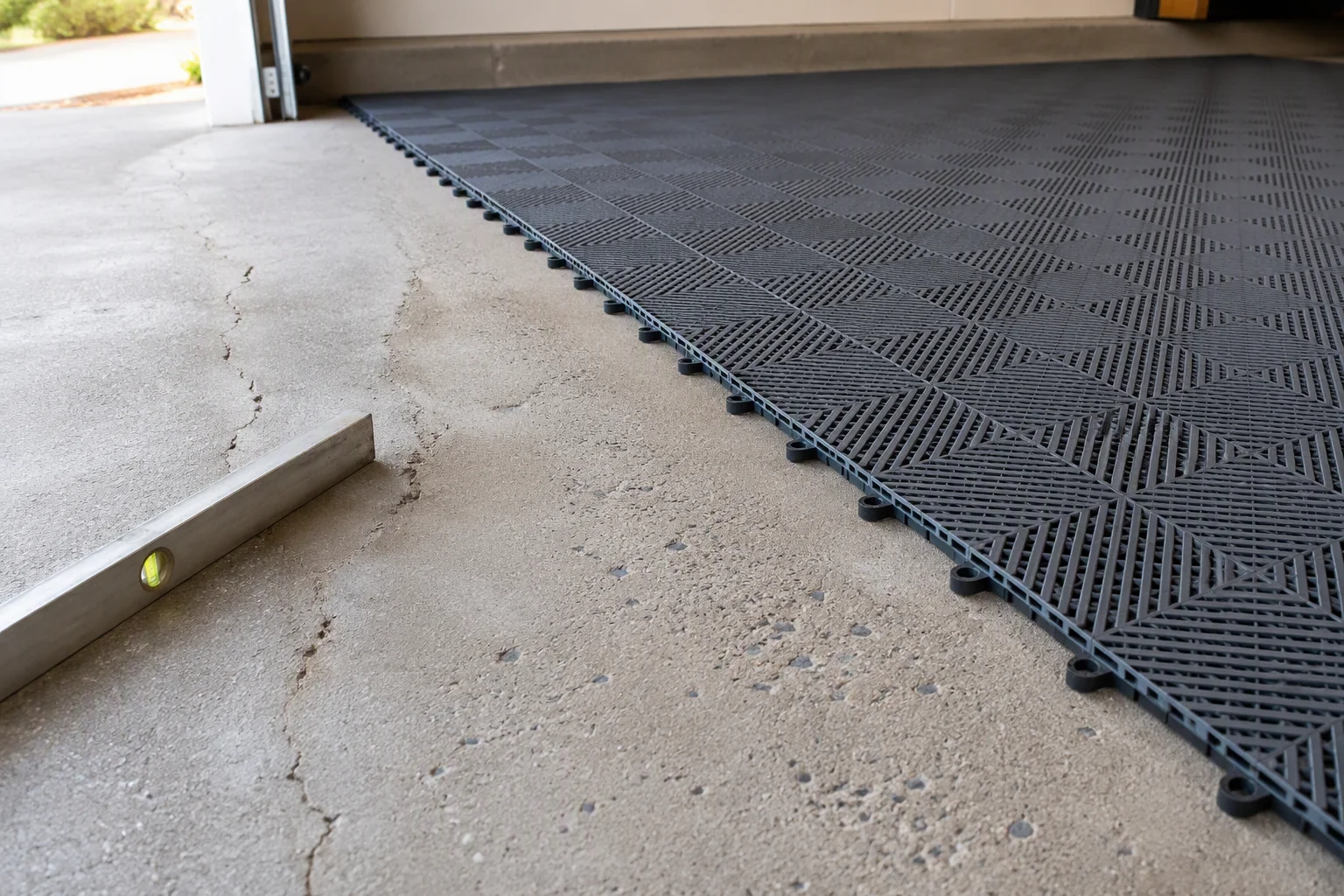
- Minor unevenness. Check it with a straight edge. If a 1 m straight edge shows a gap under about 3–4 mm, most tile systems sit flat without any preparation.
- Cracks. Clean out loose debris, then note whether the width changes with temperature. Dormant cracks are harmless underneath; cracks that open and close seasonally mean the slab is still moving and you should repair first.
- Slope. A floor pitched toward the door is ideal, not a problem — it is what stops water pooling. Tiles follow the slope, and the panels stay visually level line to line.
- Pitting and spalling. Scrape off anything loose, sweep thoroughly, and fill hollows large enough to make a panel rock. Small pits simply go unnoticed under a 10–15 mm tile.
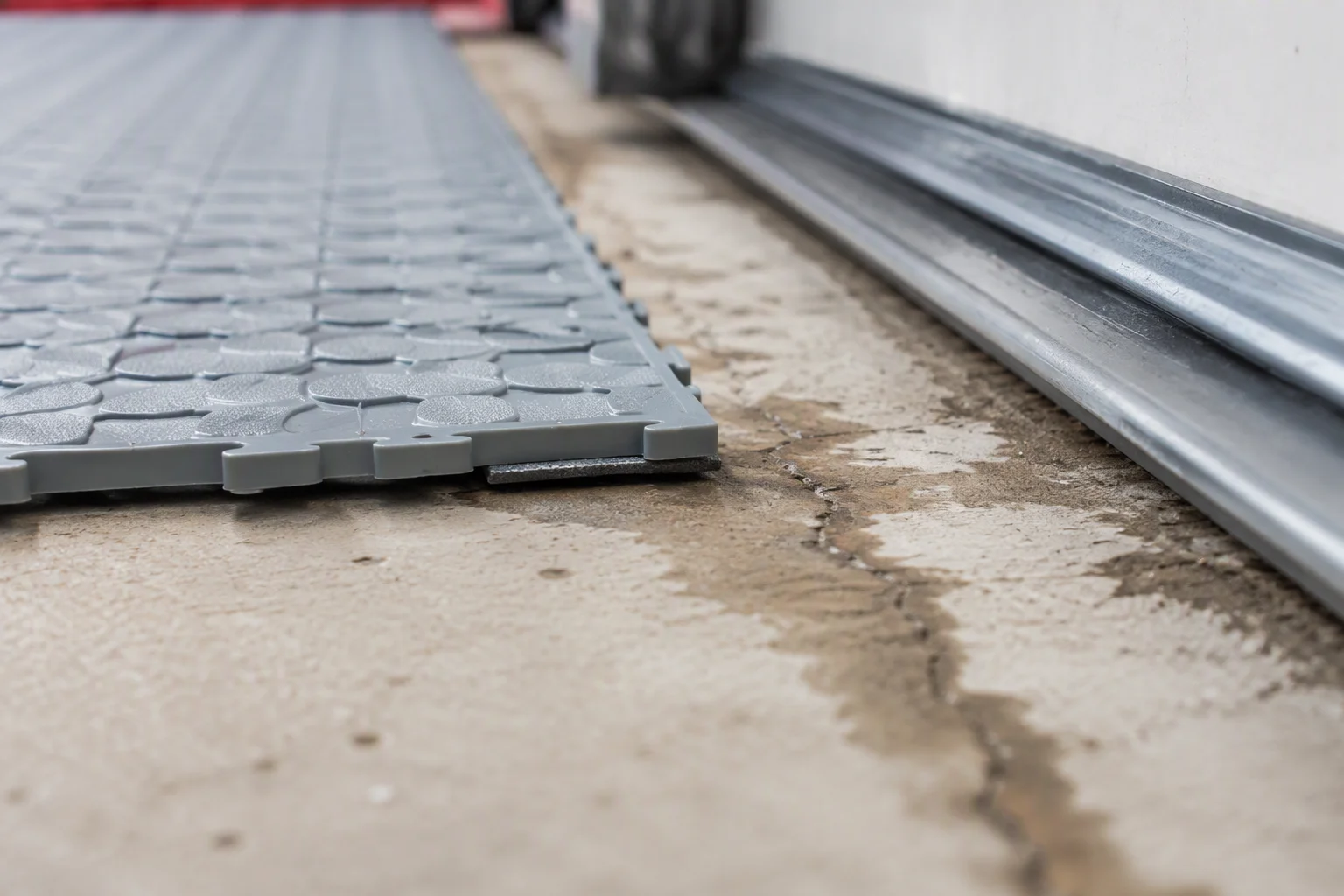
- Expansion joints. Tiles are not bonded to the slab, so they can cross a joint without cracking. If the joint has a raised lip, orient the tile grid so seams land alongside it rather than directly on top.
- Deep dips. This is the one case that needs real work. A self-levelling compound over the low area, fully cured, gives the panels something flat to sit on. Our guide to installing around posts, steps and drains covers the same levelling approach in more detail.
- Existing coatings. If the slab already has epoxy or paint, the tiles sit straight over it — see our guide to installing over epoxy. Loose or flaking coating should be scraped back first.
Do You Need to Level the Slab First?
Only if the unevenness would let the panels rock. A simple test:
- Place a tile panel on the worst area.
- Press down on each corner in turn.
- If the panel tips or rattles, the slab needs attention there.
- If it sits solid and silent, the unevenness is within tolerance.
On a proper installation the fix is almost always local — a patch of levelling compound over one low spot, not a whole-garage resurfacing job.
Frequently Asked Questions
Can I install garage floor tiles over a cracked slab?
Yes, in most cases. Interlocking tiles are not bonded down, so a dormant crack underneath has nothing to propagate into. Clean out loose material, and treat actively widening cracks as a structural repair first.
Do garage floor tiles need a perfectly level floor?
No. They need a floor that is reasonably flat — no significant dips that let a panel rock. Small variations of a few millimetres are absorbed by the rigid panel spanning across them.
What if my garage floor slopes toward the door?
That slope is a feature, not a defect, and tiles handle it without modification. Keep the slope so melt water and washdown still drains out, and make sure the apron outside the door also falls away from the building.
Can I lay tiles directly over an old, dusty slab?
Sweep and vacuum first. Fine dust and loose grit act as an abrasive layer between the tile and the slab, which causes squeaks and uneven wear at the seams. A clean slab matters more than a flat one.
Is a moisture barrier needed under the tiles?
Not usually. The open underside of interlocking tiles lets the slab breathe and any incidental moisture evaporate. If your slab has a genuine damp problem, address the drainage outside the garage rather than trapping it under a membrane.
Will an uneven floor make the tiles squeak?
Squeaks come from movement, which comes from rocking panels or trapped grit. Fix the low spot, clean the slab properly, and the floor stays quiet. This is worth checking before you commit to a covering, which is why the same point comes up in our load and weight capacity guide.
How thick do tiles need to be for a rough slab?
A thicker panel spans irregularities more comfortably. Our thickness guide explains which grades suit uneven or heavily used floors.
Can I install tiles over uneven concrete in cold weather?
Yes, but let the panels acclimatise indoors first so the connectors are flexible enough to seat properly — the process is covered in our guide to installing tiles in cold weather.
The Bottom Line
Uneven concrete is rarely a reason to abandon a tiled garage floor. Interlocking panels span the small stuff, tolerate cracks, follow a drainage slope and need no adhesive bond — which is exactly why they suit old slabs so well. Check for rocking panels with a straight edge and a test tile, fix any local low spot, sweep the surface clean, and the rest takes care of itself.
Not sure whether your slab is within tolerance? Send us a photo and the approximate depth of the worst dip and we will tell you whether prep is needed: browse garage floor tiles.


