


Garage Floor Tile Colors: How to Choose the Right One
Garage Floor Tile Colors: How to Choose the Right One
Color is the one decision you can't change with a wrench. Choose right and the garage feels finished the moment you park in it. Choose wrong and you'll notice it every single day — usually because of how the floor handles dust, or because it fights with the rest of the house.
Here's how to pick a garage floor tile color that still looks right in five years.
Start With What You Park On It
The floor's job decides its best color. Ask what happens in this space most days:
- Daily driver parking: mid-greys hide tire dust and road grime far better than anything else
- Working garage (tools, welding, spills): darker charcoals and graphite tones mask oil and metal marks
- Gym or hobby room: lighter greys and warm tones brighten the space and read as a living area
- Show car or detailing bay: light greys with a bold border photograph well and highlight clean lines
The Three Palettes That Always Work
If you want to skip the decision fatigue, these three combinations are proven in thousands of garages:
- Charcoal field, light grey border. The default for a reason — dark enough to hide dirt, light enough to reflect some light
- All mid-grey. Lowest maintenance visually; seams and scratches disappear because everything is one tone
- Light grey field, charcoal or red border. Brighter and more designed; the border contains the visual mess around the edges of the garage
Two-tone layouts also make it easier to define zones, which we cover in garage organization planning — and if you want pattern options like checkerboard or racing stripes, our pattern installation guide walks through the layout math.
Light vs Dark: The Dirt Reality
This is the part nobody tells you before you buy:
| Color | What It Hides | What It Shows |
|---|---|---|
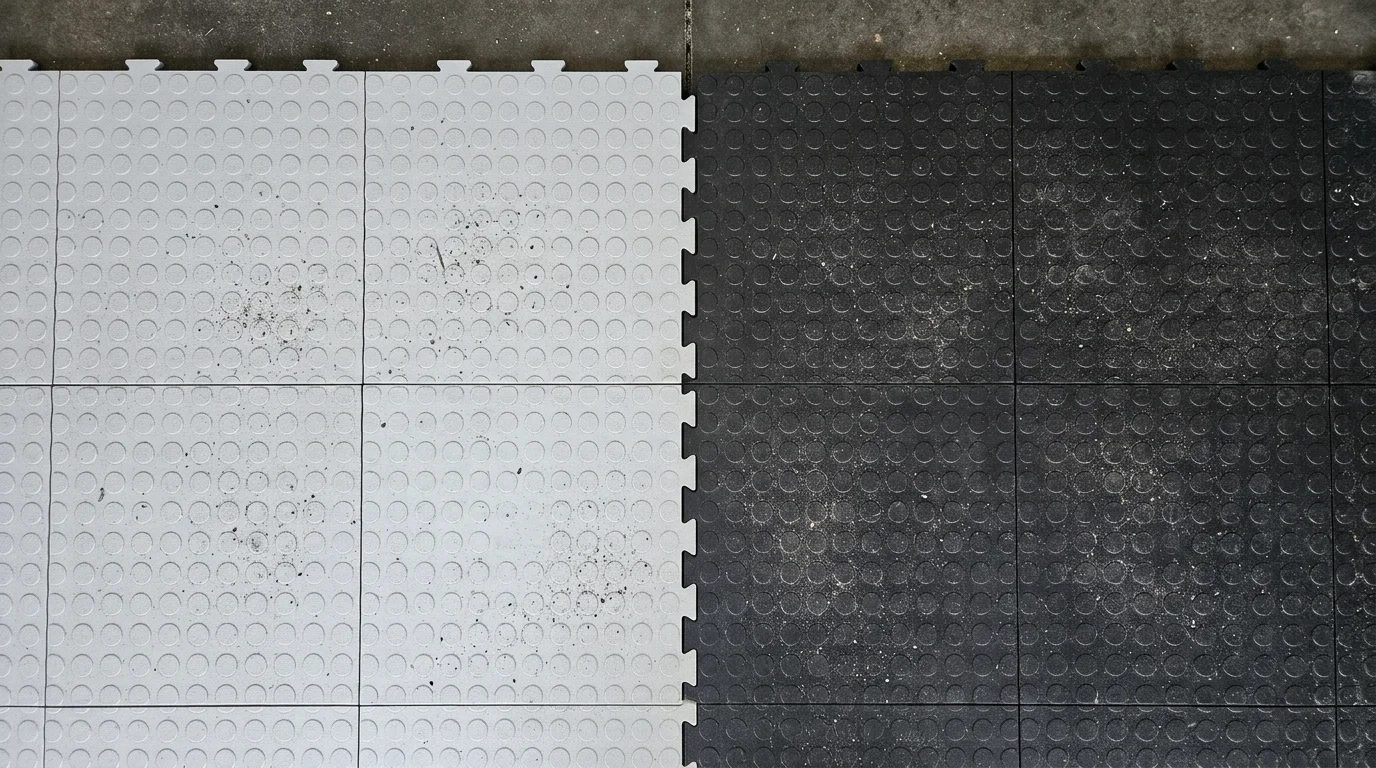
| Light grey | Oil spots, tire marks, shadows | Fine dust, sawdust, dry dirt |
| Mid grey | Almost everything at a distance | Very little — the safest choice |
| Charcoal / black | Oil, coolant stains, tire rubber | Dust, salt residue, light scratches |
| White / light accents | Nothing | Every speck — use for borders only |
The practical rule: mid-grey as the field, darks for the work zone, light or colored tones for borders. White floors look incredible in photos and terrible in real life, unless someone cleans them twice a week.
Contrast Rules That Always Work
- Two-tone maximum. Field color plus one accent is plenty; three or more turns busy fast
- Keep contrast moderate. A mid-grey field with a darker charcoal border reads premium; black next to white reads racing grid
- Repeat a color from the house. Matching your roof, trim or garage door color ties the space together
- Go warm in cold climates. Slightly warmer greys and dark browns feel less industrial than cool blues when the garage is often cold
Color and Perceived Space
Color changes how large and bright a garage feels before you touch the lighting:
- Small garage: lighter field colors make the space feel wider; a dark floor on a small garage shrinks it further
- Low ceiling: lighter floor plus light ceiling increases perceived height
- Long narrow garage: a border running the length of the space emphasizes the length rather than fighting it
- Wall color: light walls plus a light-to-mid floor makes the whole room feel open; dark walls plus dark floor is moody but needs good lighting
If your garage is tight, pair color choices with a lighter field tone and a border that runs the length of the space — the same zone logic we use in small garage organization.
Matching Your Home and Your Car
A garage floor is visible from the driveway, so it participates in your home's exterior:
- Grey house, grey roof: charcoal floor with a light border is the natural fit
- Warm brick or beige siding: greys still work; warm brown or tan tones tie in better than cool blue-greys
- Red or dark cars: mid-grey floors let the car be the focal point; light floors with colored borders also frame them well
- White or silver cars: darker floors create contrast that makes the car pop

Five Color Mistakes to Avoid
- All white or all black. White shows every mark; black shows every dust particle and scratch
- Cutting the field from a single production batch without spares. Color can vary slightly between batches — see our thickness and grade guide for why you keep extras
- Choosing from a phone screen. Order a tile sample and look at it in your own garage light, morning and evening
- Too many colors. Each added color is another thing that can look dated in five years
- Ignoring the border. The border is what makes a floor look designed rather than just covered
FAQ
What is the most popular garage floor tile color?
Mid-grey and charcoal dominate for a practical reason: they hide tire dust and oil better than any other tone. Light grey with a darker border is the most requested two-tone combination.
Do light or dark garage floors show more dirt?
They show different dirt. Light floors reveal dry dust and sawdust; dark floors reveal salt residue and fine dust as a pale film. Mid-greys hide both reasonably well.
Can I mix tile colors in the same garage?
Yes, and zones are the best reason to. Keep it to two tones — a field color plus a border or work-zone accent — so the space reads intentional rather than busy.
Will garage floor tile colors fade?
Quality polypropylene tiles are color-through, so scratches don't reveal a different color underneath, and UV degradation is minimal in a covered garage. Cheap surface-tinted tiles are the ones that fade and chalk.
The Bottom Line
Pick the field color by what the garage has to hide, add one accent color for structure, check a real sample in your own light, and keep spares from the same batch. Do that and the floor still looks like a deliberate choice years later.
Ready to choose? Browse garage floor tiles in every color option and order samples before you commit.


