


Garage Floor Tiles vs Polyaspartic Coating: Which Is Better?
Garage Floor Tiles vs Polyaspartic Coating: Which Is Better?
Two options dominate the modern garage floor conversation: interlocking garage floor tiles, which click together over an existing slab, and polyaspartic coating, the high-solids resin system that professional installers spray or roll onto concrete. Both produce a floor that shrugs off oil, road salt and hot tyres. They get there in completely different ways — and the difference decides which one belongs in your garage.
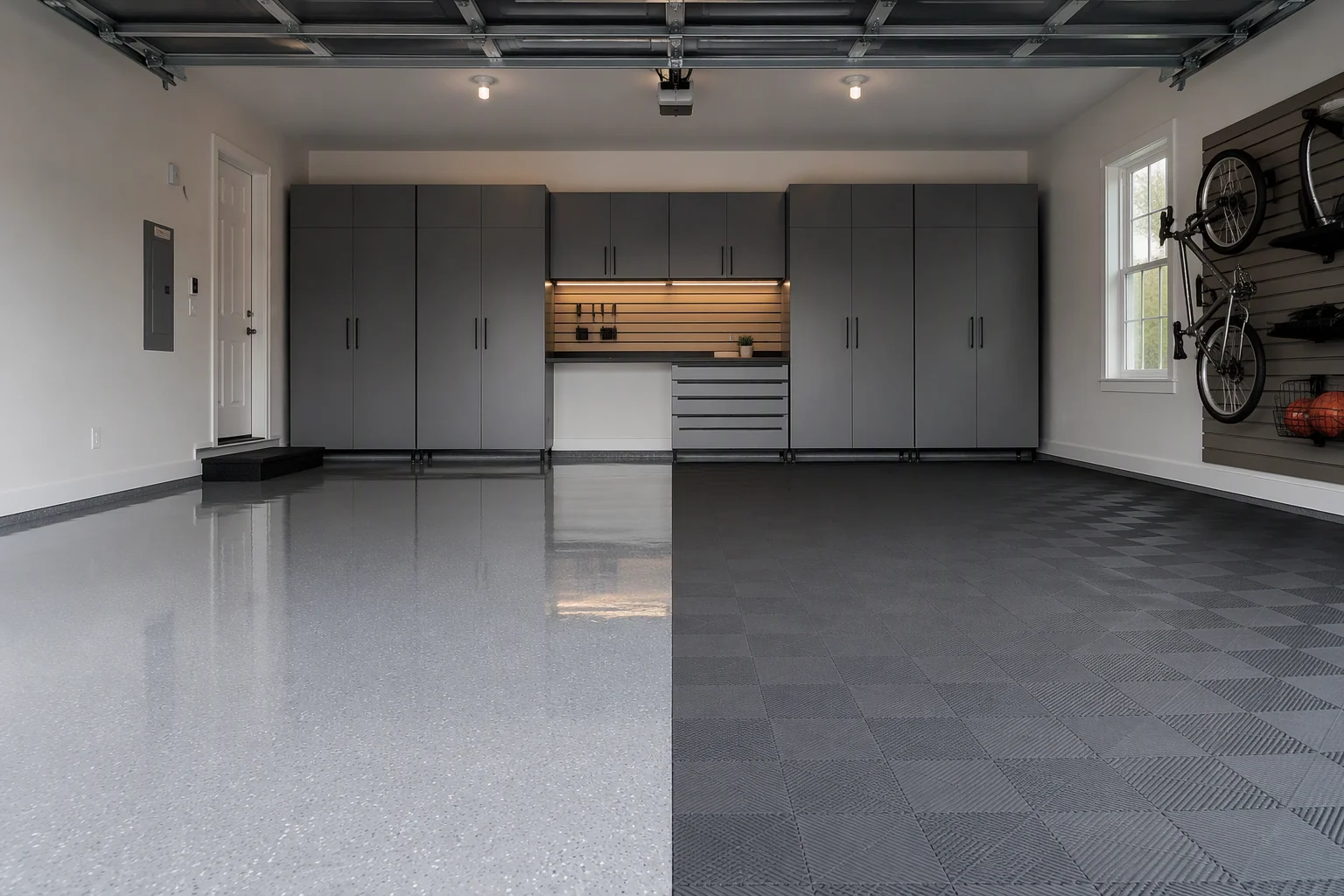
What Polyaspartic Coating Actually Is
Polyaspartic is a two-part aliphatic polyurea resin. It is often described as "epoxy's faster cousin" — but the chemistry is genuinely different. Where epoxy cures slowly and yellows under UV, polyaspartic cures in a matter of hours, stays colour-stable in sunlight, and remains slightly more flexible, which helps it resist cracking as concrete moves.
Installation is a multi-stage process: diamond-grinding the slab, repairing cracks and spalls, applying a primer, broadcasting decorative flakes or quartz if desired, then sealing with one or two polyaspartic topcoats. Done properly, it becomes a seamless, chemically bonded surface with no joints at all.
What Garage Floor Tiles Are
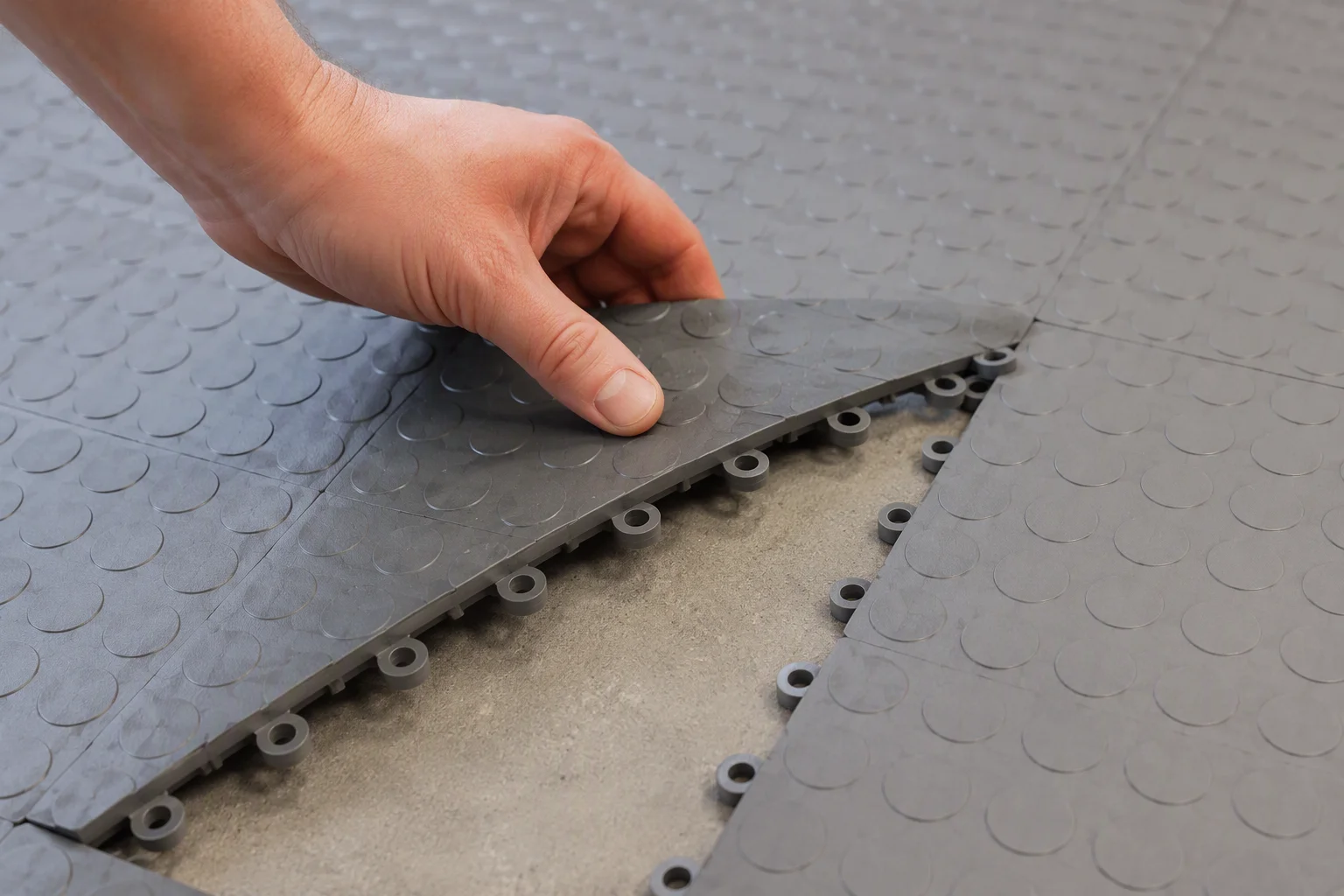
Interlocking garage floor tiles are modular polypropylene panels — commonly around 12" × 12" or 12" × 24" — with loop-and-tab connectors on the edges. They press together by hand into a floating floor that sits directly on the slab, with no adhesive, no grinding and no curing time.
Because the floor is modular, it is also repairable in a way coatings are not: if one tile is stained, scorched or cracked, you lift it and click in a replacement. The rest of the floor is untouched. Our guide to replacing a damaged tile walks through that in about ten minutes.
Head-to-Head Comparison
| Factor | Garage Floor Tiles | Polyaspartic Coating |
|---|---|---|
| Installation | DIY, no prep beyond sweeping | Professional, requires grinding and curing |
| Downtime | Usable immediately | Typically 24 hours before traffic |
| Moisture tolerance | Unaffected by slab moisture | Needs dry slab and moisture testing |
| Repair | Swap a single tile | Requires re-coating a section |
| Surface feel | Warm, textured, quieter underfoot | Hard, smooth, glossy |
| Design flexibility | Change patterns or colours anytime | Fixed once cured |
| Removability | Lift and relocate | Permanent |
| Best for | DIY, rental, damp slabs, heavy use | Showroom finishes, professional installs |
Cost: Upfront vs Total
Coating usually wins on the headline number if you price only materials — a single garage kit can look inexpensive. But the realistic comparison includes surface preparation. Diamond grinding, crack repair, moisture mitigation and the labour to apply a multi-stage system are what make a professional polyaspartic job a significant investment, and a slab that fails a moisture test may need additional primer or a moisture barrier before anything else goes down.
Interlocking tiles have a higher material cost per square metre at the till but almost no preparation cost, because sweeping is the only prerequisite. There is no curing window, so you are not paying for the garage to sit empty. Over a long horizon the two can converge — but the cash-flow shape is very different, and tiles can be installed in stages as budget allows.
If you are working to a fixed budget, our breakdown of whether garage floor tiles are worth it covers where the money actually goes.
Durability and Lifespan
Polyaspartic is genuinely tough. It resists abrasion, road salt and most chemicals, and because it is bonded to the concrete it will not shift or lift. Its weak points are impact and hot-tyre scuffing — a dropped tool or a hot tyre can mar the surface — and once the bond is compromised at a crack, moisture can creep underneath and lift the coating from below. Repair means recoating, and blending a patch invisibly into an aged floor is difficult.
Interlocking tiles absorb impact rather than resisting it: the panel flexes and the connector spreads the load. They are impervious to slab moisture, road salt and most chemicals. The realistic wear items are surface scuffs in high-traffic lanes and UV fading on very sunny driveways, both cosmetic. Individual panels that reach end of life are simply replaced.
Maintenance and Cleaning
- Tiles: sweep or hose down, mop with a neutral cleaner, spot-treat oil with a degreaser. Stubborn marks come out with the methods in our stain removal guide. Frost heave and salt residue in winter are handled by simply rinsing the surface.
- Coating: sweep and damp-mop. Avoid abrasive pads, which dull the gloss; avoid strong solvents, which can soften the film. Expect to refresh a clear topcoat periodically in a working garage.
Neither is high-maintenance. Coatings reward gentler cleaning products; tiles tolerate almost anything.
Installation and Downtime
This is where the two diverge most sharply.
- Tiles: a typical two-car garage is a weekend project for one person. No grinding, no dust, no fumes, no curing. You can park on it the same day, and you can lay it in sections — the same approach we describe in the guide for tiling around posts, steps and drains.
- Coating: grinding generates dust and noise, the resin has a working window that punishes hesitation, and the floor must stay clear while it cures. Weather also matters — cool, humid conditions slow the reaction, which is why professional crews schedule around the forecast.
Tiles also remove the biggest risk in any coating project: slab moisture. A damp slab that fails a moisture test can disqualify a coating entirely, whereas tiles sit on top and are unaffected.
Appearance and Design Options
Coating delivers something tiles cannot: a continuous, jointless surface. Flake or quartz broadcasts hide imperfections in the slab and give a showroom-quality look, and a high-gloss topcoat reflects light in a way that makes a small garage feel larger.
Tiles answer with pattern and texture. You can build a checkerboard, a border, a colour-coded parking bay or a walkway using different panels — see our pattern installation guide — and change the scheme later without redoing the floor. If you value warmth underfoot, sound deadening or slip resistance in a working garage, tiles are generally the better feel.
Which Should You Choose?
- Choose tiles if you want a DIY install, you are renting or might move, your slab is damp or badly cracked, you want to park on it the same day, or you want a floor you can repair panel by panel.
- Choose polyaspartic if you are hiring a professional anyway, your slab is sound and dry, you want a seamless high-gloss showroom finish, and you accept that the whole floor is one permanent surface.
- Both suit working garages, detailing bays and mixed-use spaces — the deciding factor is usually preparation appetite, not performance.
One more consideration: if your garage also has to work as storage, workshop or gym, a floor that can be partially lifted and re-laid is a practical advantage. Our garage organization guide covers how flooring and storage decisions interact.
FAQ
Do garage floor tiles work over a coated floor?
Yes, provided the existing coating is sound and bonded. Tiles are a floating floor, so a well-adhered polyaspartic or epoxy surface can act as the substrate. Loose or peeling areas should be dealt with first — our guide to installing tiles over epoxy explains the checks.
Is polyaspartic better than epoxy?
It cures faster and resists UV yellowing better, but it is also more expensive and less forgiving to apply. Both are permanent, seamless coatings — the trade-off against tiles is broadly the same.
Can I install tiles and coat the rest?
You can, but keep the transition deliberate: a defined edge or trim strip where tile meets coating prevents a ragged line, and the coated area must be fully cured before tiles are laid against it.
Which lasts longer?
A properly applied coating on a sound slab may last 10–15 years before a refresh. Tiles last comparably, with the difference that individual damaged panels are replaced rather than the whole surface being recoated.
The Bottom Line
Polyaspartic coating is the choice when you want a seamless, permanent, professional-grade finish and your slab cooperates. Interlocking garage floor tiles are the choice when you want a floor you can install yourself this weekend, park on immediately, and repair one panel at a time — on a slab that might not pass a coating's moisture test.
Still weighing it up? Tell us your garage size, slab condition and how you use the space, and we will recommend the right grade and quantity: browse garage floor tiles.


