


Garage Floor Tiles vs Polished Concrete: Which Wins?
Garage Floor Tiles vs Polished Concrete: Which Wins?
Polished concrete and interlocking garage floor tiles sit at opposite ends of the garage-flooring spectrum. One is a mechanical process applied to the slab you already have; the other is a floor you lay on top of it. Both look deliberate and both handle a car — but they behave very differently once the garage is in daily use.
Here is the honest comparison.

What "Polished Concrete" Actually Means
The term covers a range of work. At its simplest, it is a slab ground with progressively finer diamond abrasives until the surface goes smooth and lightly reflective. At its most involved, it means a densifier and a chemical stain or dye, followed by a guard or sealer — and a level of sheen that ranges from satin to nearly glass.
The key consequence is that nothing new is added on top. You are permanently altering the slab with heavy machinery, dust extraction and a curing or densifying period.
Head-to-Head Comparison
| Factor | Polished concrete | Interlocking garage floor tiles |
|---|---|---|
| Who can install it | Specialist contractor with grinding equipment | Homeowner, in a weekend, no dust |
| Downtime | Days on site plus curing before use | Hours; usable immediately |
| Surface feel | Hard, cold, unforgiving underfoot | Slightly cushioned, warmer to kneel on |
| Slip behaviour when wet | Very slick unless profiled or treated | Textured, with drainage through the seams |
| Staining | Oil and salt can penetrate if unsealed | Sits on a non-porous surface; wipes up |
| Repairing damage | Re-grinding a section is invasive | Swap a single panel in minutes |
| Reversible | Effectively permanent | Lifts up at any time |
| Appearance | Seamless, industrial, elegant | Defined grid or pattern; colour options |
| Dust | Low once sealed, more if uncoated | Low; nothing to abrade |
Where Each One Wins
Where Polished Concrete Wins
- Seamless appearance. Nothing breaks the plane of the floor. In a large, bright garage this looks genuinely architectural.
- No build-up. You gain no height, which matters if the door clearance is tight.
- Heavy static loads. A jack stand or a lift foot has the slab itself directly underneath.
- Long-term durability of the surface itself. There is no coating layer to peel, because there is no layer.
- Washdown. Water sheets off cleanly toward a drain.
Where Garage Floor Tiles Win
- You can do it yourself. No contractor, no grinding, no dust extraction, no curing window.
- Grip underfoot. A textured tile surface is noticeably safer when wet, which matters most in the zones where water, salt and snow actually land.
- Safe with jacks and stands. Place a board or a jacking pad and the load spreads across the panel and the slab beneath it — the same approach our load capacity guide describes.
- Repairable by you. A scorched or stained square metre is one panel, ten minutes, no contractor visit. See our replacement guide.
- Reversible and moveable. Sell the house, rent a workshop, or simply change your mind — the floor leaves with you.
- Cleanable with pressure. Salt and slurry rinse straight through the seams; the safe settings are in our pressure washing guide.
Two Factors That Usually Decide It
Slip Resistance When Wet
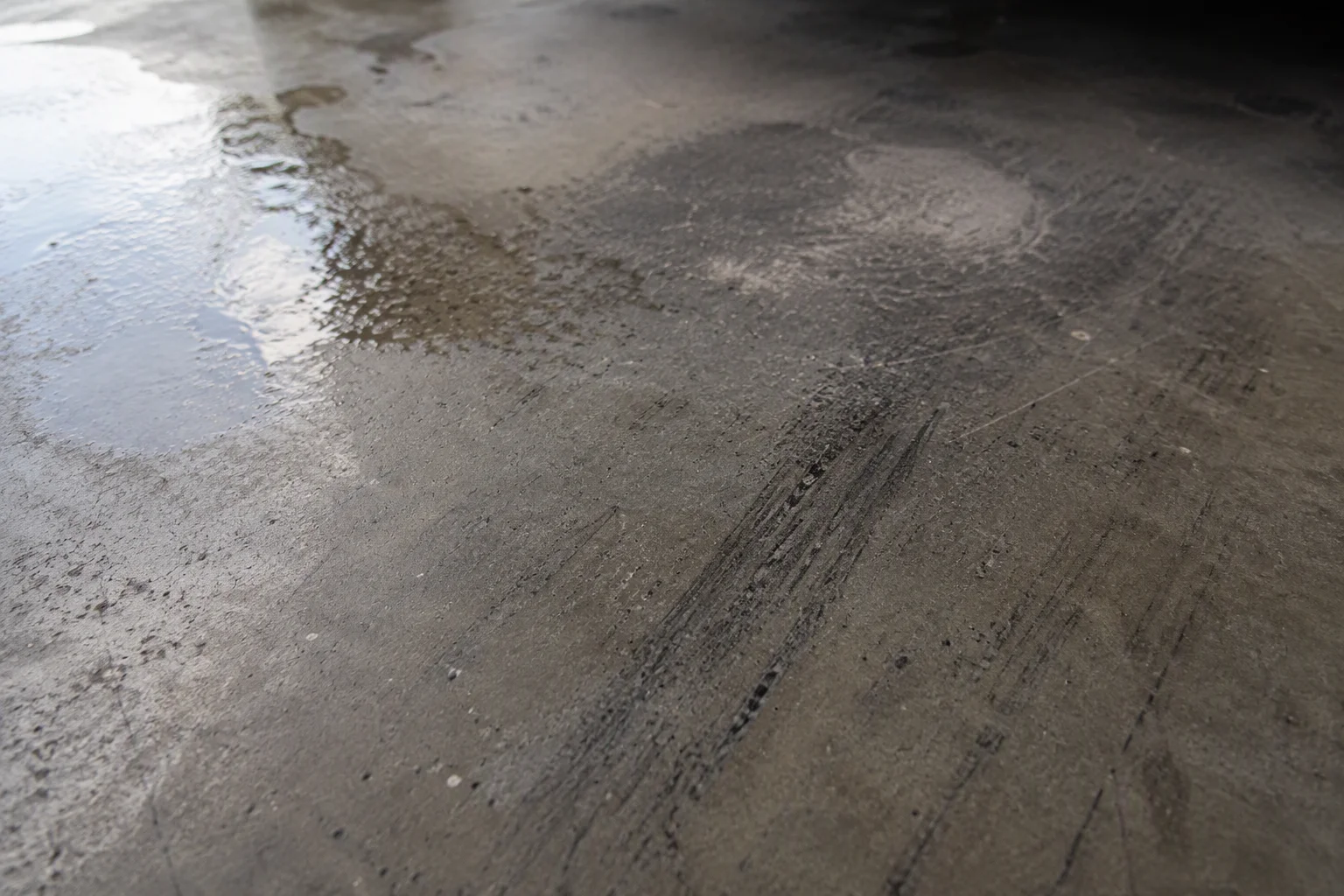
This is the deciding factor for most people, and it is easy to underestimate. A polished surface is, by definition, slick when wet. In a garage the floor gets wet from rain off the car, snow melt, washdown and spillage — which is exactly when someone walks across it carrying something.
Contractors manage this with profiling or a slip-resistant treatment, and that work is worth specifying. But it is work on top of the polishing, and it is not the same as a floor that drains through the seams itself.
Repairability and Reversibility
The second factor is what happens after something goes wrong. A polished slab that gets gouged, stained by a battery leak or scarred by a dropped tool needs a contractor, a grinder and dust extraction to put right — and the repair only makes sense if the whole floor is re-done to match.
A tiled floor fails one panel at a time. That panel lifts out in the same way it went in, and the replacement is invisible once clicked home. If your plans for the garage might change — a lift, a workshop, a move — that reversibility is worth more than any aesthetic gain.
Which Should You Choose?
- Choose polished concrete if the garage is large, bright and mostly dry, you want a seamless architectural finish, and you are happy to bring in a contractor and accept a few days of dust.
- Choose interlocking tiles if the garage sees wet cars, road salt, snow, washdown or hobby use; if you want to install it yourself; or if you want a floor you can repair, extend or take with you.
- Consider both if the slab is sound and glossy but the working zone is harsh — a tiled wash bay or entry strip over a polished slab is a genuinely practical mix.
Our broader honest breakdown of value covers where tiled floors sit against coatings generally, and the direction of garage floor design is moving toward exactly this kind of zoned approach.
The Bottom Line
Polished concrete is the better answer for a dry, architectural, professionally finished garage where the slab is the point. Interlocking tiles are the better answer for a working garage where the floor gets dirty, wet and used — because they grip, they drain, they are installed by the owner, and any damage is a ten-minute repair rather than a contractor booking.
Trying to decide between finishes for your garage? Send us a photo of the slab and tell us what the space is used for: browse garage floor tiles.
